


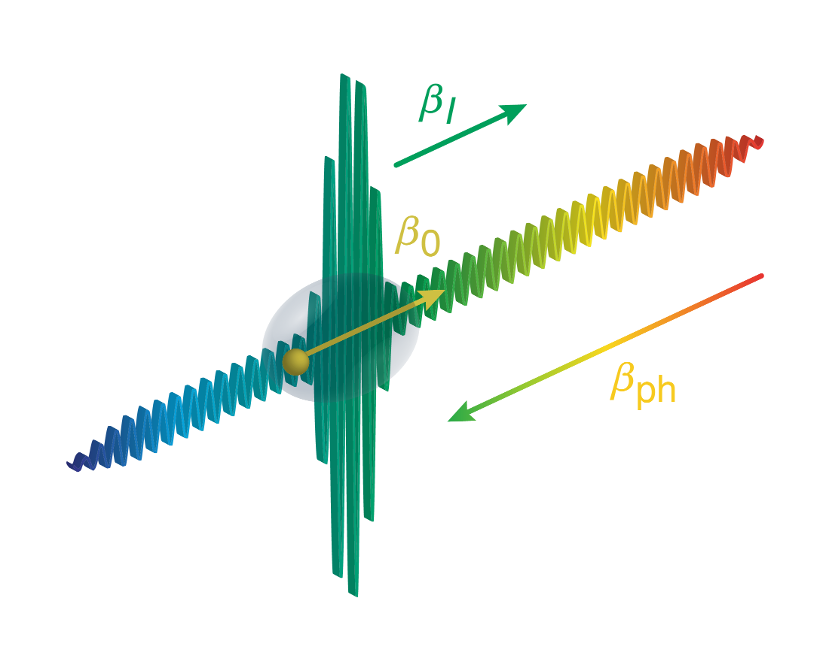
Research builds on the “flying focus” technique developed at LLE
The six-university project, with LLE’s John Palastro as a co-principal investigator, will explore how shaping laser pulses in space and time can accelerate particles, generate radiation, and guide light through air.
The University of Rochester’s Laboratory for Laser Energetics (LLE) is part of a six-university team that has received a 2026 Department of Defense Multidisciplinary University Research Initiative (MURI) award. The team will investigate how shaping intense laser pulses in space and time can provide new ways to control light-matter interactions. MURI awards are selected by the Army Research Office, the Air Force Office of Scientific Research, and the Office of Naval Research.
John Palastro, a Senior Scientist at LLE, is a co-principal investigator on the project, “Physics and Applications of Intense, Spatiotemporally Structured Light Fields.” Funded through the Air Force Office of Scientific Research and led by Howard Milchberg at the University of Maryland, the project brings together researchers with expertise in laser physics, nonlinear optics, plasma science, and structured light.
“This is an exciting opportunity to combine the strengths of the University of Rochester and LLE in theory, optical manufacturing, and high-power laser experiments with the complementary expertise of our university partners to advance our understanding of structured light–matter interactions of interest to the Air Force,” said Palastro.
What is structured light?
The MURI team will work with laser pulses that last only femtoseconds, or millionths of a billionth of a second. Within these pulses, researchers can control where the light is strongest, how its waves line up, and the orientation of its electric field. This “structured light” lets them steer the forces a pulse exerts on electrons and other charged particles. At high intensities, the light changes the material it passes through, while the material, in turn, reshapes the light. Understanding and controlling that exchange is central to the project.
Building on the flying focus
One of the primary tools the team will use, known as the flying focus, was invented and developed at LLE. This technique enables researchers to control how the peak of a laser pulse moves, independently of the speed of light. 2026 has been a milestone for flying-focus research, with three major experimental demonstrations:
- In a study published in Nature Physics, a team led by LLE scientist Charlie Arrowsmith used a flying focus to drive a laser wakefield accelerator in which the accelerating wave keeps pace with the electrons.
- In a separate study published in Nature Communications, a team led by LLE scientist Jeremy Pigeon used a flying focus to generate terahertz radiation and control its properties.
- LLE collaborators Elias Gerstmayr and Matthew Streeter at Queen’s University Belfast used a flying focus to enhance X-ray emission from the collision of a relativistic electron beam with a laser pulse.
These experiments build on concepts developed by Palastro, LLE PULSE division leader Dustin Froula, and their collaborators. Together these demonstrations highlight the potential of flying-focus technology to advance the scientific goals of the MURI.
Beyond the flying focus, the team will investigate spatiotemporal optical vortices, which feature circulating energy flows in space and time, as well as pulses that twist around their direction of travel or whose electric field orientation varies across the beam.
Three main research goals
- Compact particle accelerators. Intense laser pulses can drive strong electric fields in plasma and accelerate particles over much shorter distances than conventional accelerators. The team will investigate how shaped pulses can improve electron and ion beams and develop improved neutron sources for imaging and materials analysis.
- New radiation sources and strong magnetic fields. Shaping intense laser pulses could provide new ways to control extreme-ultraviolet light, generate intense radiofrequency and terahertz radiation, and drive currents that produce strong magnetic fields.
- Light-guiding channels in air. Laser pulses can heat air to create channels that guide a second laser beam, much like an optical fiber. The team will investigate ways to extend these air waveguides and use arrays of plasma filaments to steer microwave and terahertz radiation, with possible uses in remote sensing, communications, and energy delivery.
To support these investigations, the team will develop damage-resistant optics for shaping high-power pulses, including spiral mirrors, polarization-control optics, and dielectric metasurfaces. Experiments at advanced laser facilities will be closely integrated with theoretical modeling and computer simulations.
The research team
The other co-principal investigators are Jorge Rocca of Colorado State University, Chip Durfee of the Colorado School of Mines, Natalia Litchinitser of Duke University, and Karl Krushelnick of the University of Michigan. Researchers from the U.S. Naval Research Laboratory, Air Force Research Laboratory, Lawrence Livermore National Laboratory, and Los Alamos National Laboratory are also participating in the collaboration.
The MURI program supports fundamental research on scientific questions relevant to national defense, bringing together researchers across institutions and disciplines to address challenges that extend beyond the capabilities of a single research group.