


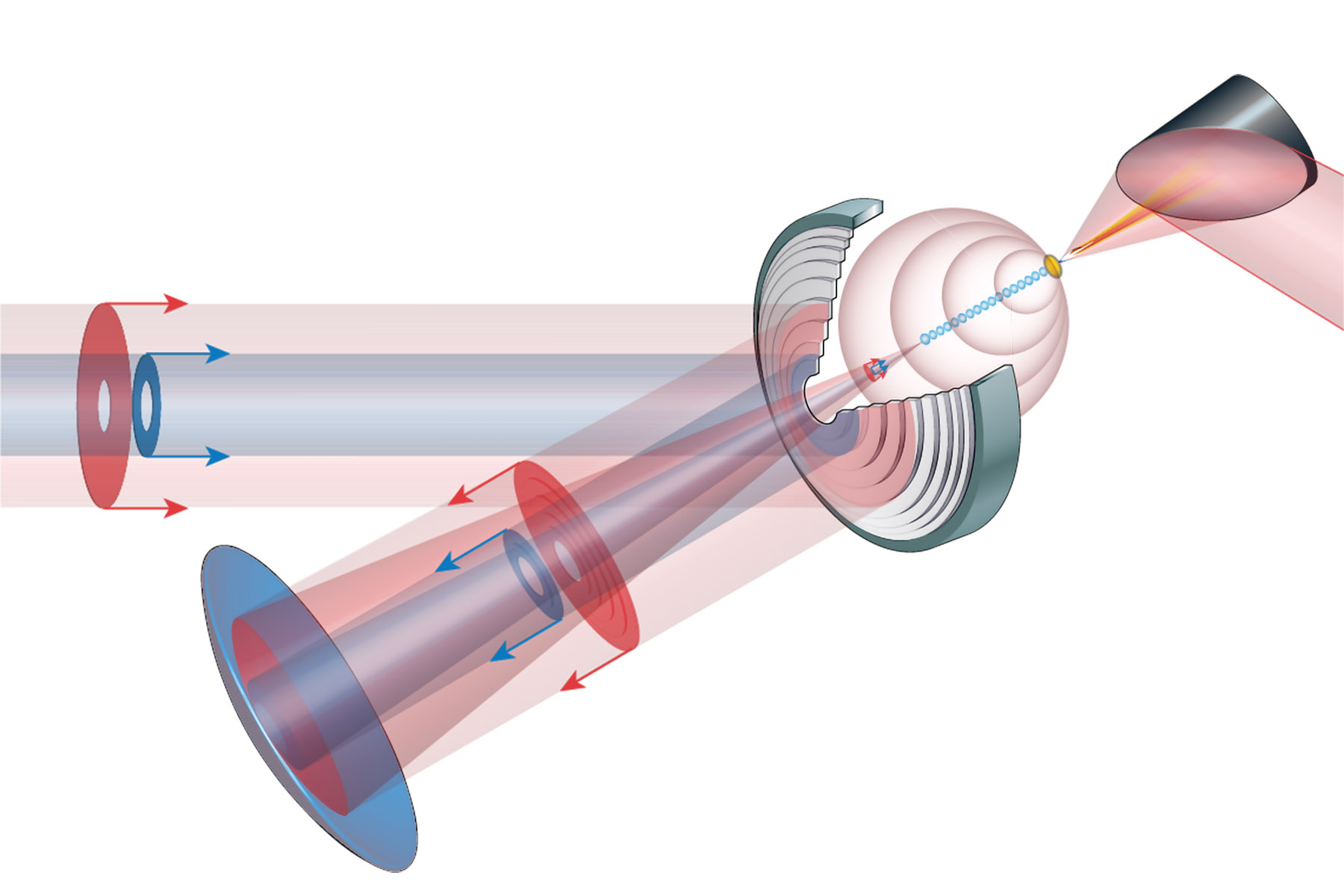
LLE is thrilled to announce the publication of new research by scientist Jeremy Pigeon and coauthors in Nature Communications. His article, “Spatiotemporal Shaping of Terahertz Radiation Produced by a Two-Color Ultrashort Flying Focus” is the second recent announcement of newly published work by LLE scientists on the flying-focus technique, an exciting emerging area of research that has the potential to open up immense possibilities in laser-plasma applications by enabling both flexibility and control over a laser beam’s focal point. Our thanks to Jeremy for taking the time to answer our questions below.
What was the main objective of your experiment?
Terahertz (THz) radiation lies between microwaves and infrared light and has applications ranging from imaging and spectroscopy to accelerator science. Our goal was to develop a new way of controlling the properties of THz radiation as it is generated. Rather than relying on conventional laser pulses, we used a specially designed laser pulse called a flying focus, whose intensity peak can be made to move faster or slower than the speed of light. We wanted to determine whether this extra degree of control could be used to shape the emitted THz radiation.
What did your results reveal?
We found that changing the velocity of the flying focus provides direct control over the emitted THz radiation. By tuning the focal velocity, we were able to modify the spectrum and temporal pulse duration of the THz pulse while also producing beams with significantly improved focusing characteristics compared with conventional two-color THz generation. These results demonstrate a fundamentally new approach for tailoring THz radiation directly at its source.
Why is this work important?
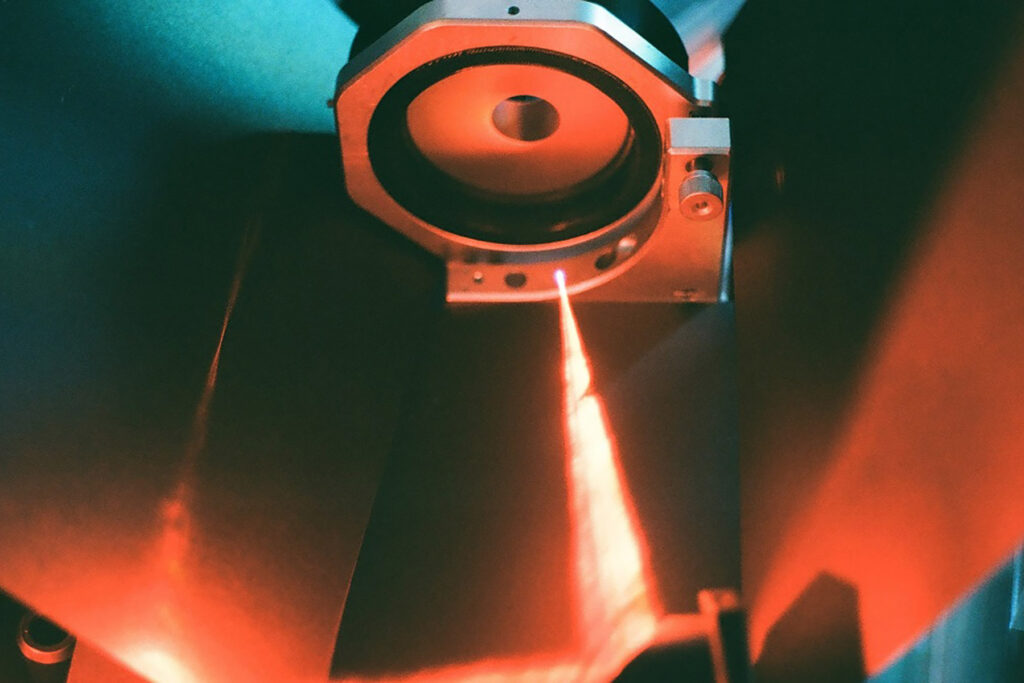
Many applications of THz radiation require beams with specific properties, but existing techniques typically shape the radiation after it has already been generated, often introducing losses or reducing performance. Our work shows that many of these properties can instead be engineered during the generation process itself. This opens new opportunities for producing brighter, more customizable THz sources that could benefit applications in spectroscopy, imaging, and advanced accelerator technologies. This was also the first time our team had produced a high-power ultrashort flying focus in the laboratory. This demonstration, will surely lead to other applications (besides THz) for this technology that URochester’s LLE has been a pioneer in.
What are your next steps?
We are continuing to investigate how spatiotemporal laser shaping can be used to control THz generation in new ways. In particular, we are exploring methods for increasing the THz pulse energy to open opportunities to study high field physics with this source or to use it as a probe for warm dense matter experiments.