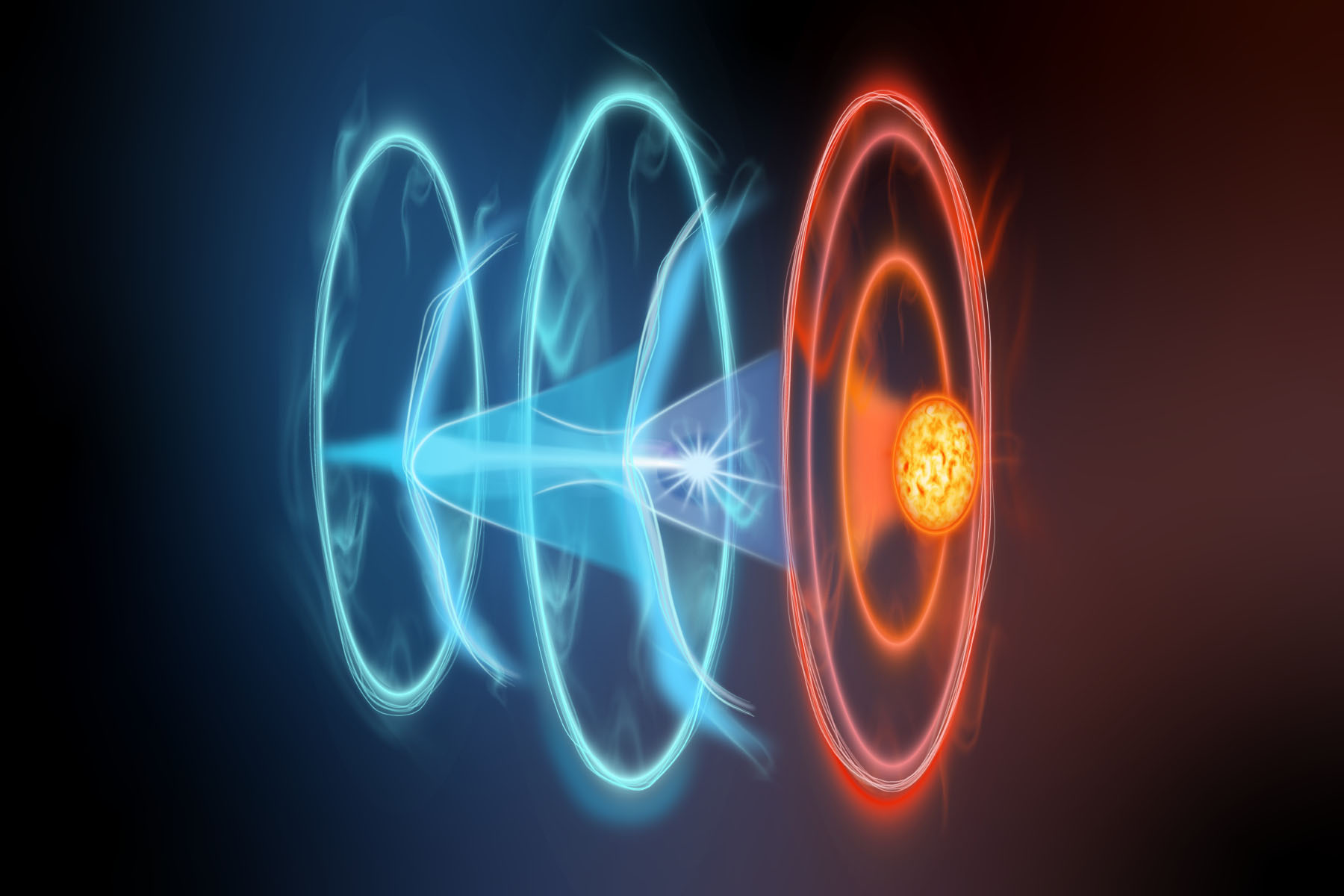
Artist's rendering of the laser-wakefield acceleration process. (Laboratory for Laser Energetics illustration/Lamisa Fairooz.)
Congratulations to LLE Assistant Scientist Charlie Arrowsmith and his coauthors, a team of scientists from the PULSE (Plasma & Ultrafast Laser Science & Engineering) Division and Laser Development Group, on the publication of their groundbreaking research in Nature Physics. In their new article, “Dephasingless Laser-Wakefield Acceleration of Electrons Using a Flying Focus,” Arrowsmith and his team demonstrate for the first time how the flying focus technique—a method developed to control the speed of a laser focus over long distances—can be used to overcome longstanding limitations in a laser-plasma accelerator. This breakthrough may one day enable TeV energy electron beams to be produced in a meter-sized accelerator.
Our thanks to Charlie for taking the time to answer our questions about this important work.
“These results are a powerful example of what makes LLE unique: the ability to bring together expertise across divisions to enable truly innovative science.”
–Dustin Froula, PULSE Division Director
What was the main objective of your experiment?
The main objective of our work was to demonstrate that a flying focus can ensure that the electrons do not catch up to the laser pulse in a laser-plasma accelerator—an effect known as “dephasing.” These accelerators can provide fields 1000x stronger than conventional technology by making particles surf on the wake behind an intense laser pulse as it propagates through a plasma, as shown in the animation below. Dephasing is caused when accelerating electrons start catching up with the laser, which propagates in the plasma at slightly slower than the vacuum speed of light. It has the effect of terminating the acceleration and limiting the maximum achievable energy.
Visualizing Flying Focus
In this animation, we see a laser pulse reflecting off a radial echelon and an axiparabola to produce a flying focus. The axiparabola has a radially dependent focal length, creating an extended line focus, while the echelon has steps to add time delay to different radii of the pulse to control the velocity of the peak intensity along the extended line focus. We zoom in on the pulse just as it reaches the focus and enters the plasma. Inside the plasma, the laser focus drives a plasma wave, shown by the glowing blue structure. Electrons can get trapped inside this wave and accelerate, remaining in phase with the plasma wave and yielding dephasingless laser-wakefield acceleration. (Laboratory for Laser Energetics animation/Michael Franchot.)
What did the results reveal?
We conducted our experiment on the MTW-OPAL Laser System, which provides a window into the ultrafast physics planned to be explored with NSF OPAL, a future ultra-intense laser user facility currently under development at LLE. Using a flying focus, we showed that we can overcome the fundamental limitation of dephasing by making a flying focus propagate in the plasma at the vacuum speed of light, which prevents the accelerating electrons from dephasing.
One of the flagship experiments planned for NSF OPAL is to scale up dephasingless laser-wakefield acceleration to generate 100 GeV electron beams in a meter-long plasma. If successful, this will equal the highest-energy electrons ever created by humans and push the energy frontier of electron particle accelerators towards the TeV scale.
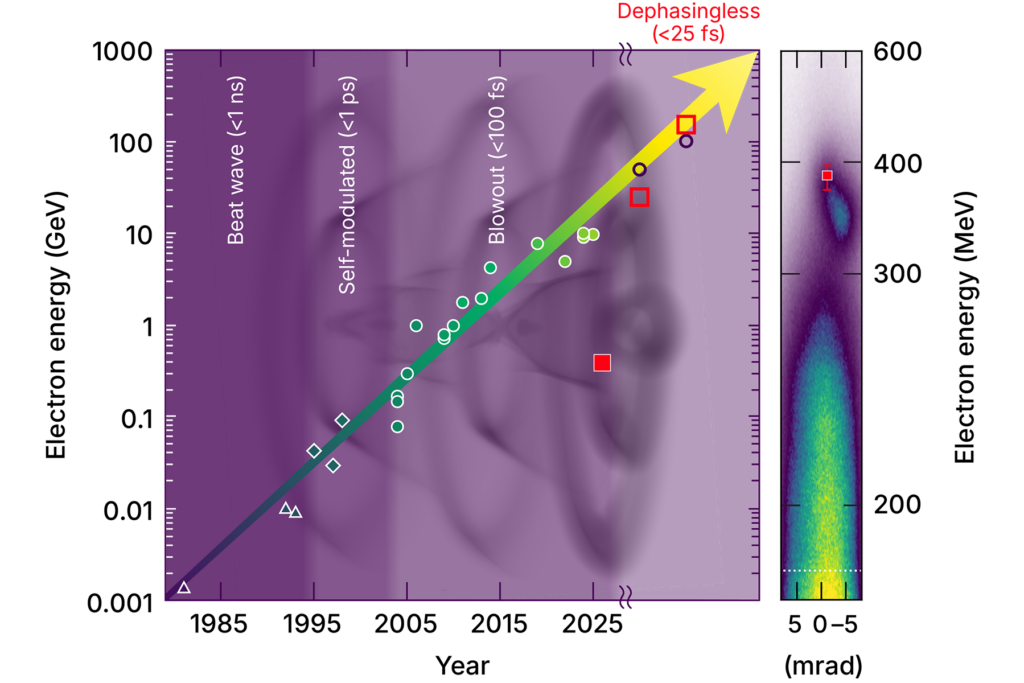
Progress in laser-wakefield acceleration over the past four decades has been driven by major advances in laser technology, from nanosecond beat-wave lasers to today’s ultrashort femtosecond systems. At each stage, the community developed new acceleration regimes that sustained rapid growth in achievable electron energy. The latest breakthrough, demonstrated this year, is dephasingless laser-wakefield acceleration (right panel), which uses ultrashort (<25 fs) laser pulses to accelerate electrons in higher-density plasmas with stronger accelerating fields while preventing the electrons from outrunning the laser driver. This concept opens a potential path toward compact accelerators capable of reaching energies far beyond current limits. Filled symbols show experimental results achieved over the years, including the recent dephasingless acceleration results (red square), while open symbols represent simulated accelerator concepts that are helping guide future development. (Laboratory for Laser Energetics figure/Rodi Keisidis.)
Why is this work important?
This work potentially opens up the possibility to produce 100-GeV electron beams in a meter-length plasma using near-future laser facilities such as NSF OPAL. This would equal the energy of electrons produced in the 1990s at the Large Electron-Positron Collider at CERN and enable many exciting experiments to be conducted, including unique possibilities to test the breakdown of our theory of quantum electrodynamics in the strong-field limit.
What are your next steps?
Work has begun to design bespoke optics in order to carefully control the flying-focus velocity for perfect matching to the accelerating electrons. To achieve this, a novel fabrication process has been developed in-house by LLE’s Optical Manufacturing Group. LLE will be the first place in the world to build and use these optics and demonstrate the potential of this technology.