Timeline – 2025
The Omega Laser Facility Surpasses 50,000 Shots
On October 28, 2025, the Omega Laser Facility surpassed 50,000 target shots. The facility houses the largest lasers of any university research institution in the world: the OMEGA laser, commissioned in 1995, and the OMEGA EP laser, commissioned in 2008. This particular milestone was achieved on a campaign using both laser systems for a single experimental objective to advance high-energy-density physics and inertial confinement fusion research. The experiment focused on refining neutron time-of-flight and x-ray diagnostic timing and improving the accuracy of key measurements such as ion temperature and bang time. Reaching 50,000 target shots reflects not only the sustained pace of approximately 2,000 shots per year, but also the precision, coordination, and technical expertise required to operate the facility at this scale.
Angularly Resolved Thomson Scattering
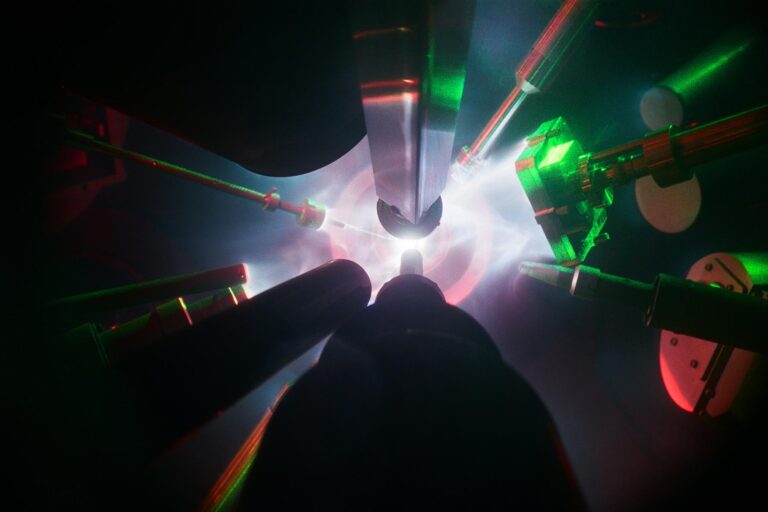
Thomson scattering is a powerful technique that precisely measures the plasma’s properties. By extending the diagnostic to capture a range of scattering angles, LLE has invented Angularly Resolved Thomson Scattering, which enables the measurement of the electron distribution function within plasmas produced on OMEGA. This technique gives detailed insight into how energy flows in a plasma, helping researchers better isolate the uncertainties in modeling plasma conditions from laser–plasma instability physics.
Critical Sustainment Activity
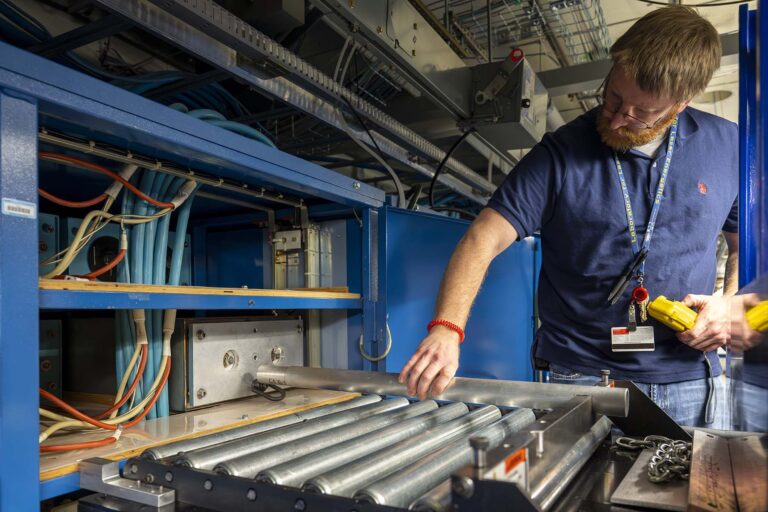
The team faced a growing challenge as 30-year-old capacitors—vital to powering the OMEGA 60‑beam laser system—approached the end of their service life. Recognizing the risk to system reliability, LLE developed a comprehensive sustainment plan to restore and replace the components. In 2025, the team advanced a dual strategy: refurbishing batches of existing units while integrating newly manufactured replacements. This approach, involving staff from multiple technical divisions, exemplifies how comprehensive sustainment strategies are essential for preserving and enhancing the capabilities of complex scientific facilities.
IFE-STAR Ecosystem
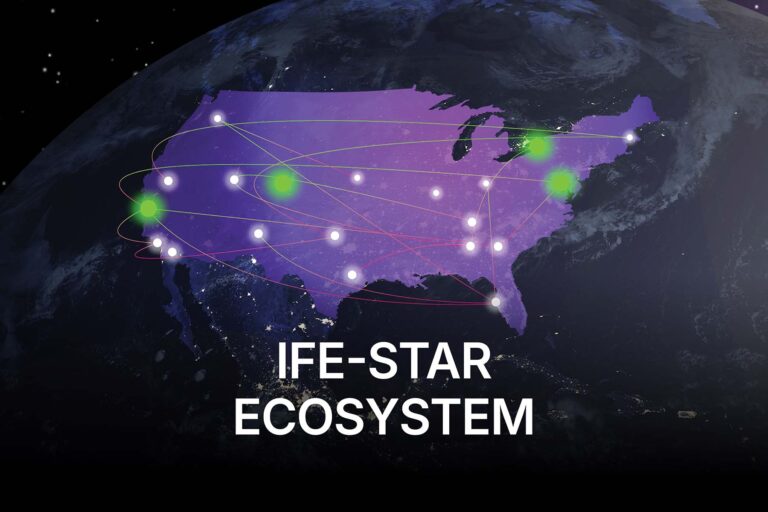
The US Department of Energy’s Office of Fusion Energy Sciences awarded a grant to LLE to establish the Inertial Fusion Energy Science and Technology Accelerated Research (IFE-STAR) ecosystem. This system brings together academia, national laboratories, and the private sector to develop a clean, safe, and virtually limitless energy source built on US leadership in inertial fusion. IFE-STAR aims to address critical objectives in IFE development, such as science and technology, enhanced coordination and collaboration among researchers, and workforce development. The IFE-STAR program brings together three leading research institutions, each spearheading a unique hub to advance IFE science and technology: LLE’s IFE Consortium on Laser–Plasma Interaction Research (IFE-COLoR), Lawrence Livermore National Laboratory’s Science and Technology Accelerated Research (STARFIRE), and Colorado State University’s Research in Inertial and Sustainable Energy (RISE).
Fellowships and Awards
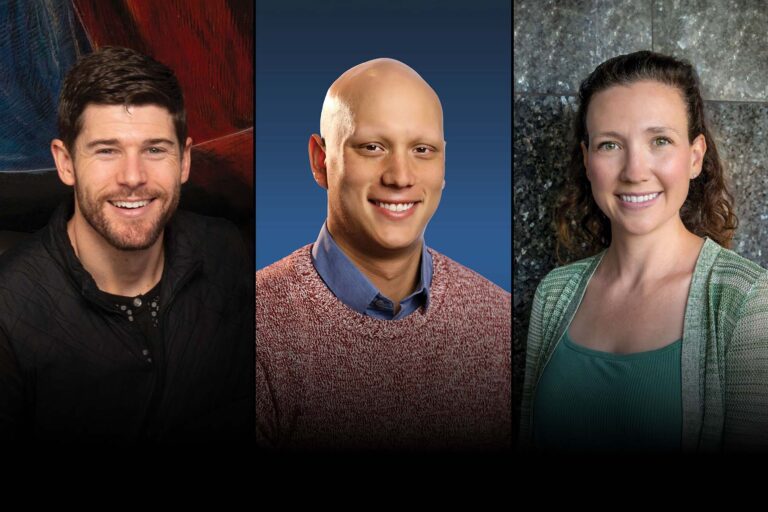
David Turnbull was honored as an American Physical Society (APS) Fellow for his groundbreaking experiments and analysis in laser–plasma interactions, advancing inertial confinement fusion (ICF) and plasma photonics. Turnbull’s contributions, including over 90 publications, have significantly impacted both direct-drive and indirect-drive National ICF Programs, contributing to the 2022 ignition milestone. David Alex Chin received the 2026 APS Topical Group on Compression of Condensed Matter Student for his innovative development of an EXAFS flat-crystal spectrometer, enabling high-resolution x-ray spectra measurements at extreme pressures. Danae Polsin earned the APS 2026 Neil Ashcroft Early Career Award for her pioneering studies of matter under terapascal conditions. Polsin’s work spans high-energy-density science, quantum matter, and planetary physics, with over 30 publications and numerous invited talks. A dedicated mentor and educator, Polsin exemplifies excellence in research and teaching at LLE.