Timeline – 2023
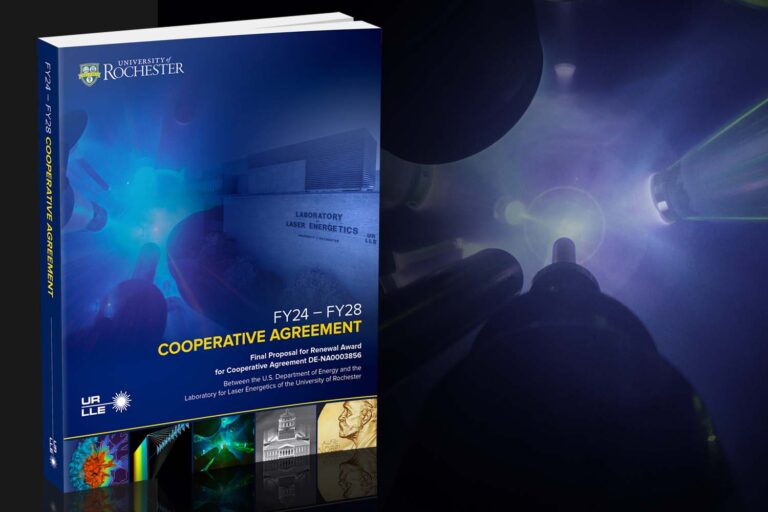
LLE Cooperative Agreement Renewed with the DOE
LLE and the US Department of Energy’s National Nuclear Security Administration (NNSA) finalized a new cooperative agreement for more than $503 million, covering fiscal years 2024–2028. This new agreement—the eighth of its kind between NNSA and LLE—reflects LLE’s significant contributions and its continued importance to NNSA’s mission. The funding will enable LLE to continue operating the Omega Laser Facility, home to two of the most powerful laser systems in the world; collaborating with the greater scientific community to develop novel diagnostics, experimental platforms, and laser technologies required for laser-direct-drive ignition; and expanding LLE’s role in high-energy-density–physics research. Additionally, an important highlight of the new agreement is its emphasis on training technicians, engineers, operators, and educators to help build and diversify the nation’s long-term workforce needs for national security.
NSF Funds Design of World-Leading NSF OPAL Laser Facility
The National Science Foundation awarded the University of Rochester nearly $18 million in funding to design and prototype key technologies for NSF OPAL (optical parametric amplifier line)—a new user facility dedicated to the study of ultrahigh-intensity laser–matter interactions. A future NSF OPAL facility, if/when constructed, would provide laser capabilities beyond those currently available internationally. It would return leadership in a field that originated at LLE with the invention of chirped-pulse amplification that was recognized by the 2018 Nobel Prize in Physics. This level of performance would open the doors to a new era of high-impact research, as envisioned in reports from the Brightest Light Initiative and Multi-Petawatt Physics Prioritization Workshops. The NSF OPAL project leverages the expertise, resources, and talents of partner institutions nationwide, including six universities and a private company.
Funding Secured for New Inertial Fusion Energy Consortium
The Hub IFE-COLoR (Inertial Fusion Energy-Consortium on LPI Research) received $10 million in funding from the US Department of Energy’s Office of Fusion Energy Science to advance research on inertial fusion energy science (IFE) and technology. Led by the University of Rochester, the Hub brings together a first-class lineup of experts from the University of California, Los Angeles and the University of Nebraska-Lincoln, and the private sector (Ergodic, LLC and Xcimer Energy Corp.) to build the scientific case that will determine a technologically viable path to IFE. Research will directly address the most-significant science issues that currently pose challenges to the development of an IFE facility by setting the requirements for a direct-drive high-bandwidth laser driver that significantly reduces laser imprint and mitigates laser–plasma instabilities at IFE conditions.
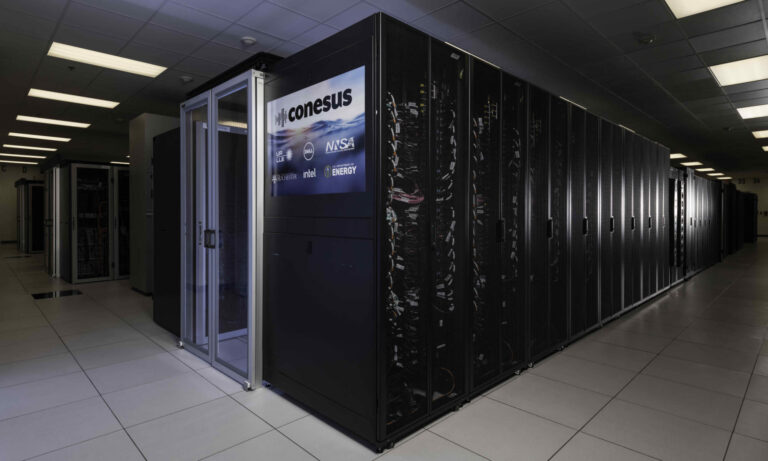
LLE Conesus Supercomputer Ranked One of the World’s Most Powerful
A new supercomputer housed at the University of Rochester will make it possible for researchers to simulate complex high-energy-density phenomena in inertial confinement fusion in three dimensions with unprecedented details. The supercomputer, dubbed “Conesus” after one of the Finger Lakes, also uses artificial intelligence and machine-learning tools to advance progress in high-energy-density science. Manufactured by Intel and developed in partnership with Dell Technologies and Lawrence Livermore National Laboratory, Conesus is one of the most-powerful and energy-efficient computer systems in the world, having already received several impressive distinctions and rankings on the TOP500 and Green500 lists.
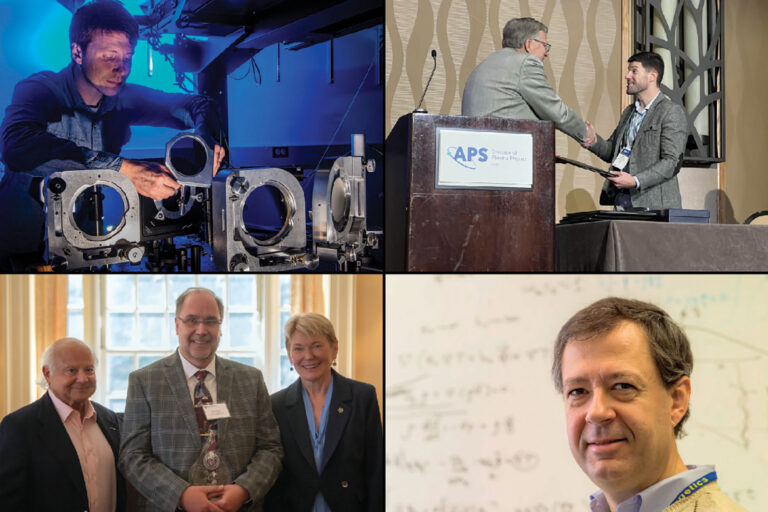
LLE Receives Major Awards
Top left: Jeremy Pigeon, a Scientist in the Plasma & Ultrafast Laser Science & Engineering Division, was awarded a 2024 Young Investigator Research Program from the Department of the Air Force.
Top right: David Turnbull received the 2023 Thomas H. Stix Award for his outstanding contributions in pioneering experiments on plasma photonics and laser–plasma instability. Demonstrating exceptional scientific leadership, Turnbull has developed into a significant national player in both indirect-drive and direct-drive inertial confinement fusion programs.
Bottom left: David VanWey, HR/Benefits Representative and Lead Analyst/Programmer at LLE was awarded the University of Rochester Witmer Award for Distinguished Service. The Witmer Award is presented to staff members whose careers have been characterized by outstanding and sustained contributions to the University.
Bottom right: Riccardo Betti, Chief Scientist at LLE, was awarded the European Academy of Sciences’ Blaise Pascal Medal. The award was given “in recognition for his outstanding contributions to high-temperature plasma physics with applications to nuclear fusion and for the development of the novel ‘shock-ignition’ approach to direct-drive inertial confinement fusion.”