Timeline – 2020
Remote Principal Investigator (PI): Bringing the Omega Laser Facility to the PI
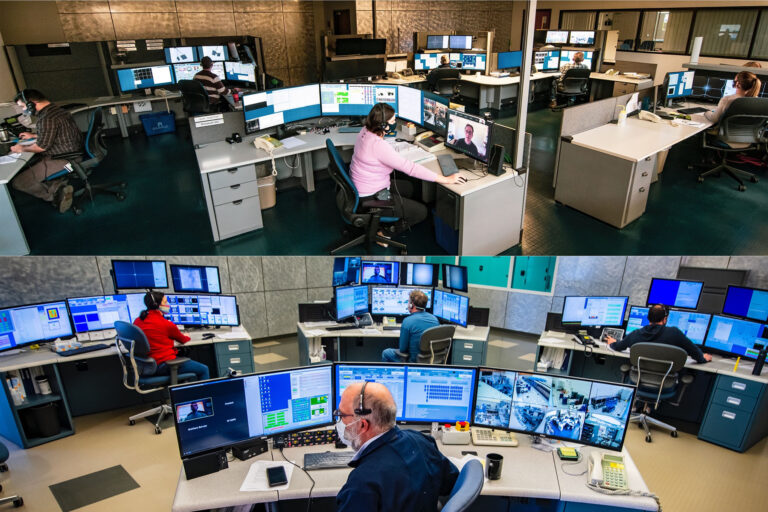
To adapt to social distancing, travel restrictions, and other safety measures necessitated by the COVID-19 global pandemic, Omega Operations and the LLE Information Technology (IT) Group collaborated to develop a new protocol that enables principal investigators (PIs) to safely and effectively conduct laser experiments via remote access. Users need only a device and internet connection to participate. The remotePI option has proven to be an efficient tool that has delivered significant operational and economic advantages. These adaptations resulted in many requests from investigators to continue the venue of remotePI post-pandemic restrictions, allowing investigators the option of remaining at their home institutions rather than travelling long distances and permitting more collaborators to participate in the experiments remotely.
The Center for Matter at Atomic Pressures Funded by the National Science Foundation
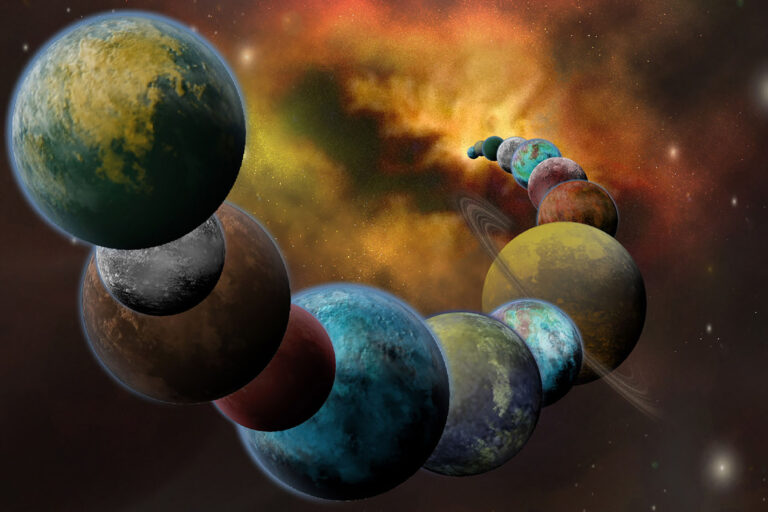
The Center for Matter at Atomic Pressures (CMAP) was awarded $12.96 million toward research focusing on understanding the physics and astrophysical implications of matter under pressures so high that the structure of individual atoms is disrupted. The Principal Investigator is Rip Collins, University of Rochester Professor of Mechanical Engineering and Physics and LLE’s Associate Director for Academics, Science, and Technology. The program will be hosted at the University of Rochester in collaboration with researchers from MIT, Princeton, the Universities of California at Berkeley and Davis, the University at Buffalo, and Lawrence Livermore National Laboratory. This is the first major initiative from the National Science Foundation in the field of high-energy-density science, and the research will help discover the nature of planets and stars throughout the universe, as well as the potential for new revolutionary states of matter here on Earth.
Patent for LLE Technology Awarded
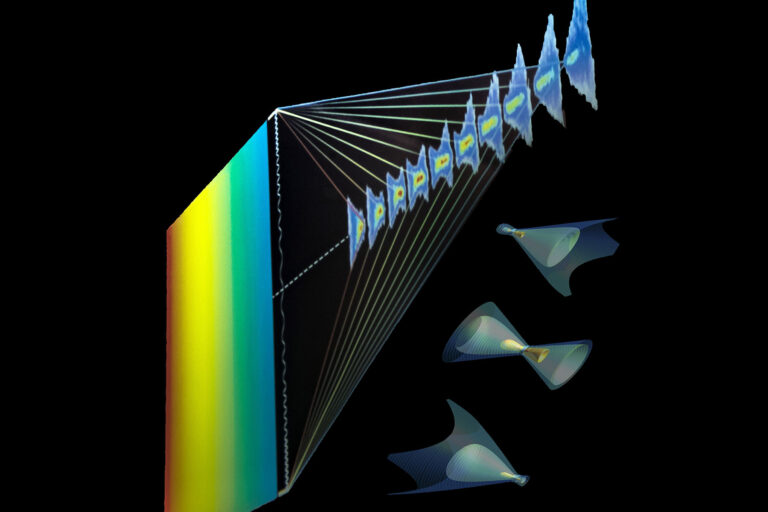
A patent was awarded for “System and Methods for Spatiotemporal Control of a Laser and Laser-Plasma Applications that Require Velocity Matching,” by LLE’s Plasma and Ultrafast Physics Group Leader, Dustin Froula, and Optical and Imaging Sciences Group Leader, Terry Kessler.
D. H. Froula and T. J. Kessler, “Systems and Methods for Spatiotemporal Control of a Laser and Applications of Same,” U.S. Patent No. 10,897,115 B2 (19 January 2021).
LaserNetUS Receives $18 Million from the US Department of Energy
LaserNetUS, a network of facilities operating ultra-powerful lasers, including the Omega Laser Facility, received $18 million in funding from the Department of Energy. In its first year of user operations, LaserNetUS awarded beamtime for 49 user experiments to researchers from 25 different institutions. Over 200 user scientists including well over 100 students and post-docs have participated in experiments so far. The network and future upgrades to LaserNetUS facilities will provide new opportunities for US and international scientists in discovery science and in the development of new technologies.
10,000th Shot on the Multi-Terawatt Laser
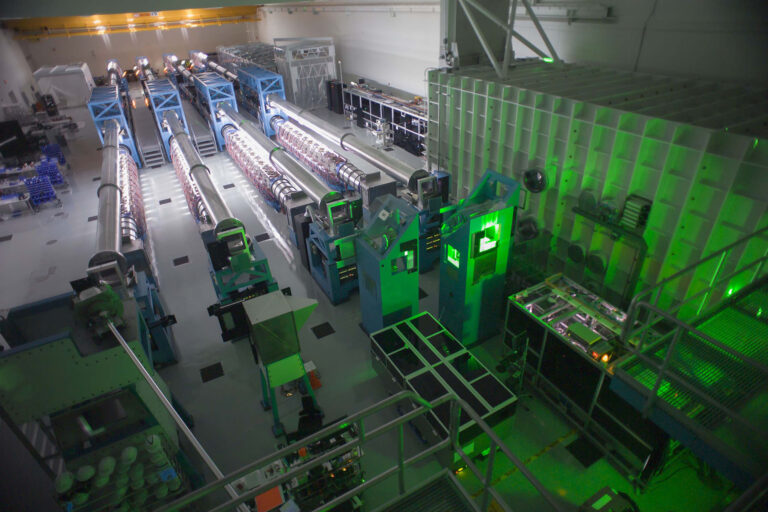
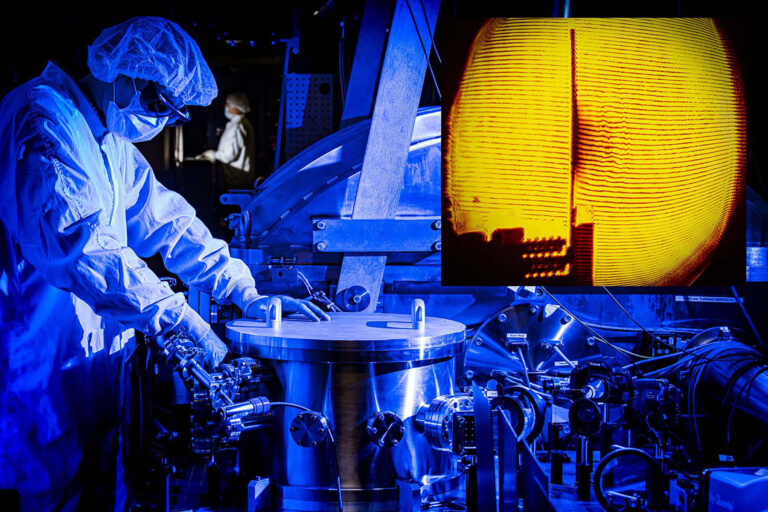
On May 26, 2020 the Multi-Terawatt (MTW) Laser operational team celebrated their 10,000th laser shot. The first shot on the MTW laser, a midscale system built initially as the prototype front end for OMEGA EP, was taken in 2004. Since that time, a compression chamber along with three target chambers have been added, the maximum energy was increased, and the temporal contrast improved, making MTW a complete facility for plasma-physics research, laser technology development, and target diagnostic development. External and internal users have carried out 535 campaigns on MTW, using pulse durations from 500 fs to 2.8 ns, energies up to 120 J, and wavelengths centered at 1053 nm or 2ω, 4ω, and 5ω harmonics. The milestone shot was taken in support of an external campaign for L3Harris Technologies, a global aerospace and defense technology company with local roots. Two-color, laser-shearing interferometry (see inset) is used to infer spatially resolved density profiles within the ablation plume and to monitor plasma expansion into a low-density background gas. The inset image was taken during the 10,000th shot.