Timeline – 2018
Two Former LLE Researchers win Nobel Prize in Physics
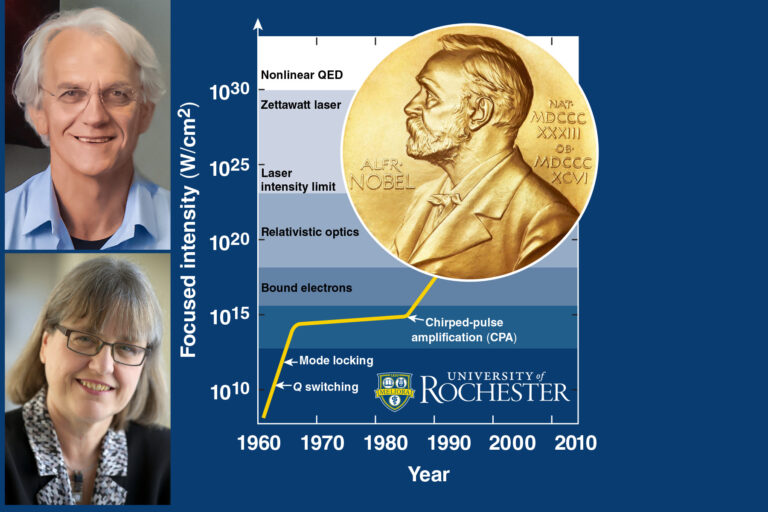
Profs. Donna Strickland and Gérard Mourou were awarded the 2018 Nobel Prize in Physics “for groundbreaking inventions in the field of laser physics” for their invention of chirped-pulse amplification (CPA) while at the University of Rochester’s Laboratory for Laser Energetics in the 1980s. Prof. Strickland developed CPA as a graduate student with Prof. Mourou as her advisor in The Institute of Optics. Strickland is only the third woman to receive the prize in physics, joining Marie Curie (1903) and Maria Goeppert-Mayer (1963). “We need to celebrate women physicists because we’re out there,” Strickland said. “I am honored to be one of those women.” Professor of Optics and former Institute of Optics Director, Wayne Knox said of Gérard Mourou, he is “one of the most visionary and creative people I’ve met in my whole life. He was always thinking about the next power of 10. If his laser was making 1018 watts per square centimeter, he wanted to build one that was a thousand times bigger.” Together, their invention revolutionized laser science, enabling amplification of ultrashort laser pulses by more than five orders of magnitude (a factor of 100,000 times).
Funding Restored for LLE and ICF Program
On September 12, 2018, Josh Farrelman from the Office of Government and Community Relations announced that the FY19 Energy and Water Bill was released to approve $80M for LLE, a $5M increase over FY 2018 and the highest level of federal funding ever appropriated to the LLE in the University’s history. $545M was approved for the Inertial Confinement Fusion (ICF) program at the National Nuclear Security Administration.
In early February the President’s Budget Request proposed a $30M cut to LLE, a $126M cut to the ICF program, and closing LLE in three years. Farrelman reported “Thanks to incredibly strong, bipartisan Congressional support led by Sen. Schumer and an outcry from the scientific community, we not only reversed a $30M cut and proposed closure of LLE, but we secured a $5M increase over last year. This represents an unprecedented $12M increase over the last two fiscal years. The $80M represents the highest level of federal funding ever appropriated to LLE in the University’s history and will serve as a critical basis for the first year of our new Cooperative Agreement with the DOE.”
Studying Planetary Magnetic Fields
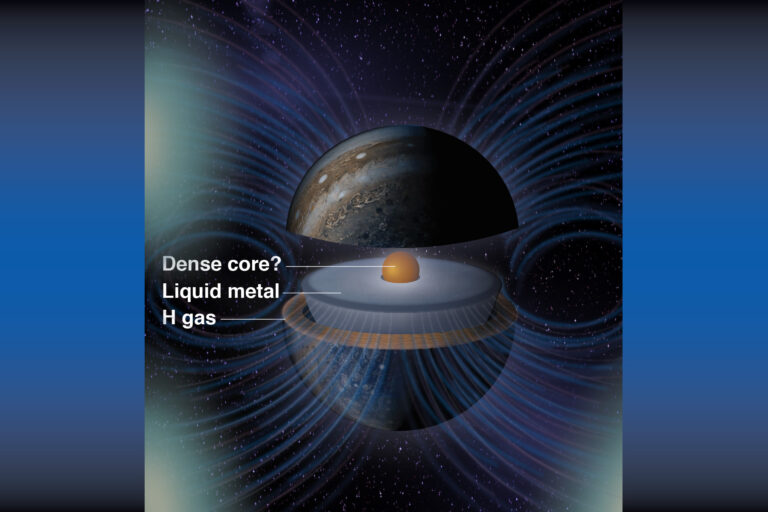
More than 80% of planets are composed of metallic hydrogen. However, metallic hydrogen is one of the rarest materials found on Earth. Mohamed Zaghoo, Research Associate, and Gilbert “Rip” Collins, Associate Director for Academics, Science, and Technology, have studied the conductivity of metallic hydrogen using experiments on the OMEGA Laser System to understand how planets form magnetic fields. Jupiter has one of the strongest magnetic fields in our solar system, and the “dynamo” mechanism that causes this is also present deep within the Earth. This dynamo creates our own magnetic field, making our planet habitable by shielding us from harmful solar particles. A key to Jupiter’s magnetic field may lie in understanding the properties of metallic hydrogen, which surrounds Jupiter’s core. A paper on their research was published in The Astrophysical Journal: M. Zaghoo and G. W. Collins, “Size and Strength of Self-Excited Dynamos in Jupiter-Like Extrasolar Planets,” Astrophys. J. 862 (1), 19 (2018).
A New Form of Water Confirmed with Experiments at LLE
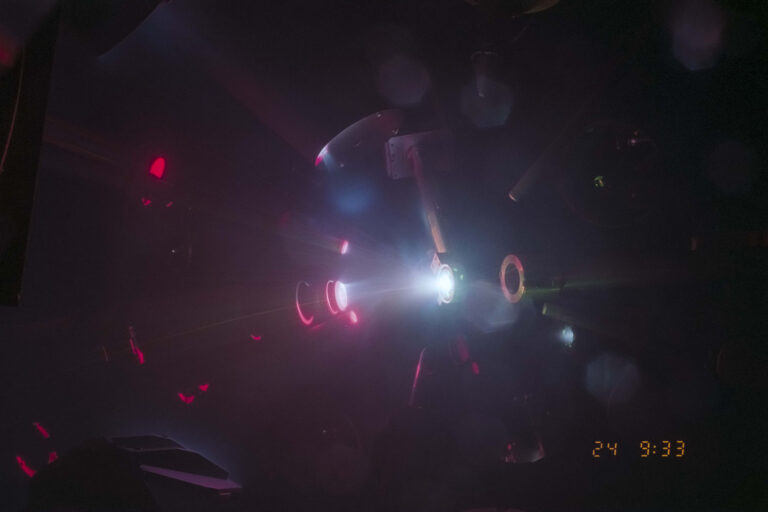
On February 5, the New York Times Science section posted an article featuring an experiment conducted at LLE under the Laboratory Basic Science Program and was published in the journal Nature Physics [M. Millot, S. Hamel, J. R. Rygg, P. M. Celliers, G. W. Collins, F. Coppari, D. E. Fratanduono, R. Jeanloz, D. C. Swift, and J. H. Eggert, “Experimental Evidence for Superionic Water Ice Using Shock Compression,” Nat. Phys. 14 (3), 297–302 (2018)]. The paper discusses a new form of water that is simultaneously solid and liquid and highlights experiments conducted by a team of scientists from Lawrence Livermore National Laboratory (LLNL), the University of California Berkeley, and the University of Rochester and led by Marius Millot, a physicist at LLNL. This new form of water is called “superionic water” and is not known to exist naturally on Earth. Scientists created it by squeezing water between two pieces of diamond to create a type of ice that is about 60% denser than usual. Then, on the OMEGA Laser System, a pulse of laser light was used to heat the ice to thousands of degrees to exert a pressure more than a million times that of Earth’s atmosphere. These conditions exist inside Uranus and Neptune and undoubtedly within numerous ice giants around other stars.
Omega Demonstrates Best Ignition-Scaled Cryogenic Target Performance To Date
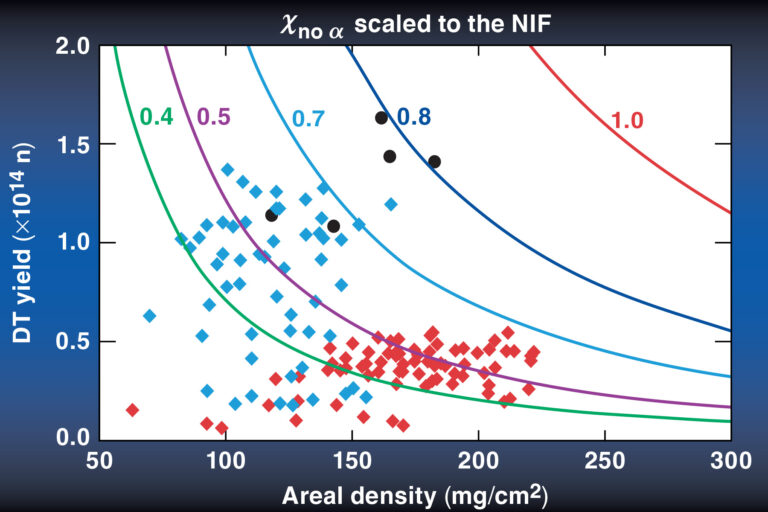
The highest-performing direct-drive cryogenic implosions to date were conducted on the OMEGA Laser System. Shown here is a plot of the yield versus the areal densities for the OMEGA cryogenic implosions. Data from the July 10, 2018 shots are shown as black circles. The generalized Lawson criterion derived by Chang [P. Y. Chang et al., Phys. Rev. Lett., 104, 135002 (2010)] are scaled to a NIF energy of 1.9 MJ and are shown as curves. The χnoα = 1 line represents the onset of ignition in an ICF implosion on the NIF. July cryogenic implosion data have crossed the NIF χnoα = 0.8 line and clearly show improved direct-drive implosion performance.