Timeline – 2017
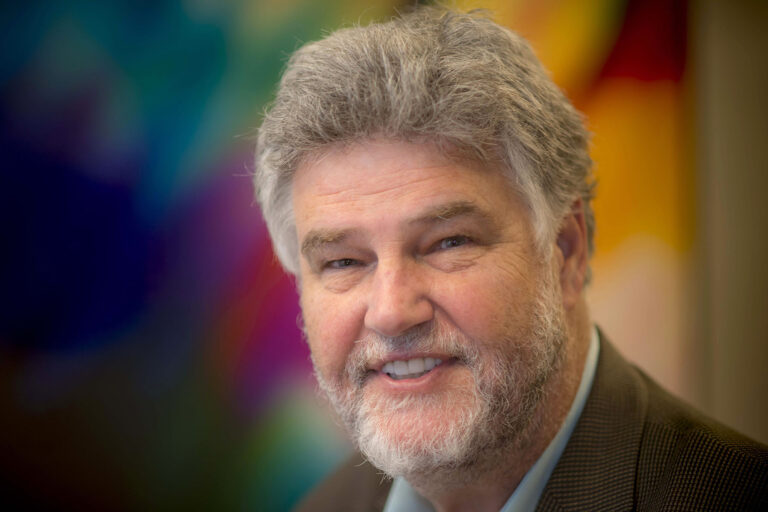
Dr. E. Michael Campbell Appointed Laboratory Director
Dr. E. Michael Campbell was named as the new Director of the Laboratory for Laser Energetics on October 1, 2017. Dr. Campbell is an internationally known expert in inertial fusion, high-energy-density physics, high-power lasers and their applications, and advanced energy technologies including Generation IV nuclear fission reactors and biofuels. He has won numerous awards including the Department of Energy’s E. O. Lawrence Award, the American Nuclear Society’s Edward Teller Award, the American Physical Society’s John Dawson Award, the Department of Energy’s Excellence in Weapons Research Award, and the Leadership Award of Fusion Power Associates. He is a Fellow of the American Physical Society and the European Institute of Physics. He has published over 100 articles in scientific journals and holds five patents including the design of the first laboratory x-ray laser. He has given numerous invited and plenary talks at both national and international conferences. He is the originator of the Inertial Fusion Science and Applications Conference.
Multi-Institutional Effort to Study “Extreme Matter”
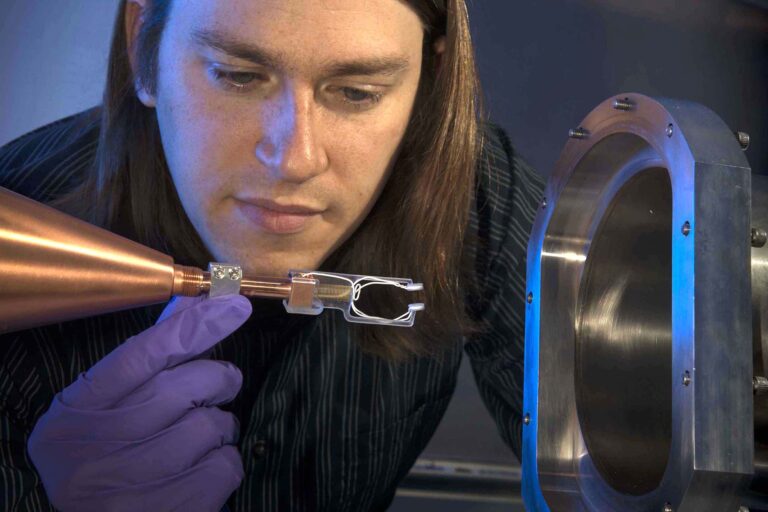
The University of Rochester is leading a seven-institution collaboration that promises to significantly broaden human understanding of “extreme matter”—matter that exists under pressures far higher than either on or inside Earth. The collaboration, with local principal investigators Profs. Pierre Gourdain, Gilbert “Rip” Collins, and Dustin Trail, includes Cornell, Michigan, Idaho State, Iowa, Princeton, and Stanford. The research team will develop an instrument called a high-amperage driver for extreme states, or HADES, which will allow scientists to produce and study extreme matter.
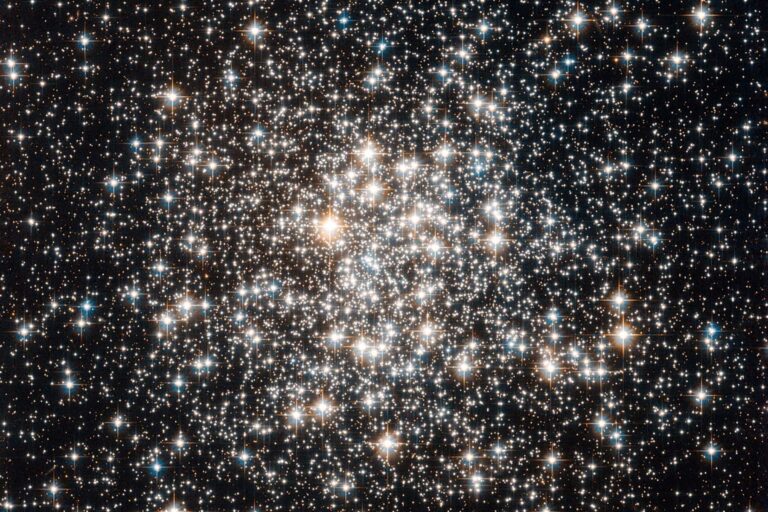
The project is fully supported by the National Science Foundation, which awarded the University a $1.1M grant in August. While extreme matter does not exist naturally on or inside Earth, it is quite common in the universe, especially in the deep interiors of planets and stars. Prof. Gourdain notes that HADES will lead to new knowledge about star formation and planetary collisions, the potential for life on other planets, and the properties of materials that make up deep-space objects.
Laser-Driven MagLIF
Sandia National Laboratories and LLE entered into a collaboration to test the scaling of magnetized liner inertial fusion (MagLIF) over a range of absorbed energy of the order of 1 kJ on OMEGA to 500 kJ on Sandia’s Pulsed-Power Facility (Z machine). This work is being funded with a two-year, $3.8M award from the Department of Energy’s Advanced Research Projects Agency-Energy (ARPA-E) to study the potential of combining these two different technologies to produce controlled fusion reactions.
Commissioning an X-Ray Detector System for Spectral Analysis of Tritium-Filled Targets
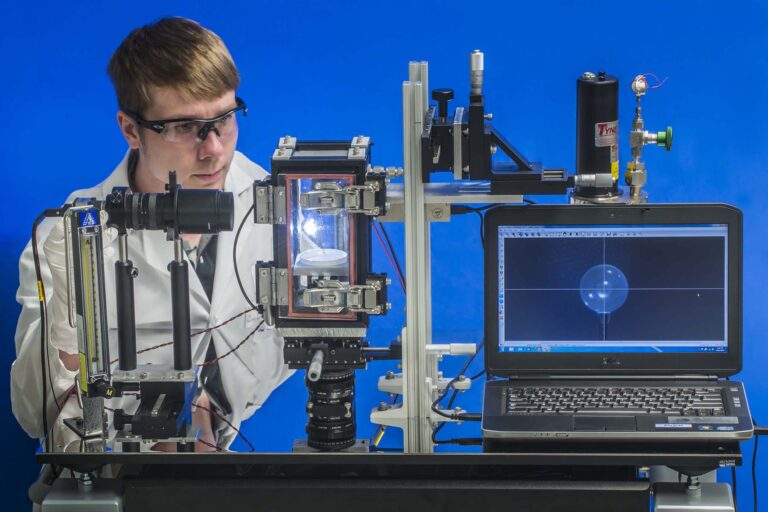
An x-ray detection system (XDS) has been modified to nondestructively measure the pressure of DT fuel inside a target just prior to a shot. The XDS comprises three primary components: a high-resolution, dual-axes imaging system for repeatable, accurate target positioning; a helium enclosure with triple-axes micrometer positioning; and an Amptek silicon drift detector (SDD). The SDD was fit with a silicon nitrate (Si3N4) window to measure x-ray energies from 200 eV to 40 keV. The detector features a 25-mm2 silicon drift diode with a measured 130-eV full-width-at-half-maximum resolution at 5.7 keV.
Dynamic Compression Sector Target Area System Installed
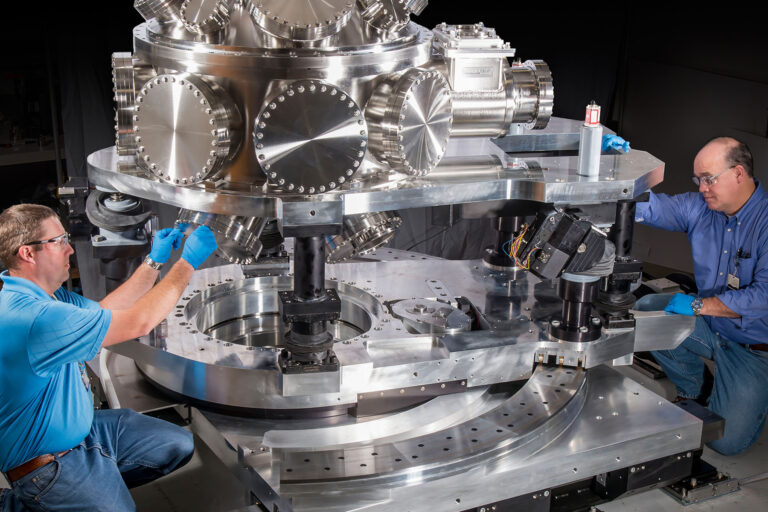
LLE’s Target Area System for the Dynamic Compression Sector (DCS) was installed at the Advanced Photon Source (APS) located at Argonne National Laboratory near Chicago. The system includes a target chamber, target positioner, and optical train to deliver the DCS laser. In addition to the port used to deliver the laser beam, the target chamber includes 15 large ports for target diagnostics and auxiliary systems and smaller ports for the Target Viewing System. The target chamber translates horizontally and vertically to align the target with various APS x-ray beam positions. The chamber also rotates through 135° to change the laser angle of incidence with respect to the x-ray beam; this supports a range of different experimental configurations. The laser beam path in the target area is an extension of the laser clean-room envelope.