Timeline – 2015
Magnetic Liner Inertial Fusion
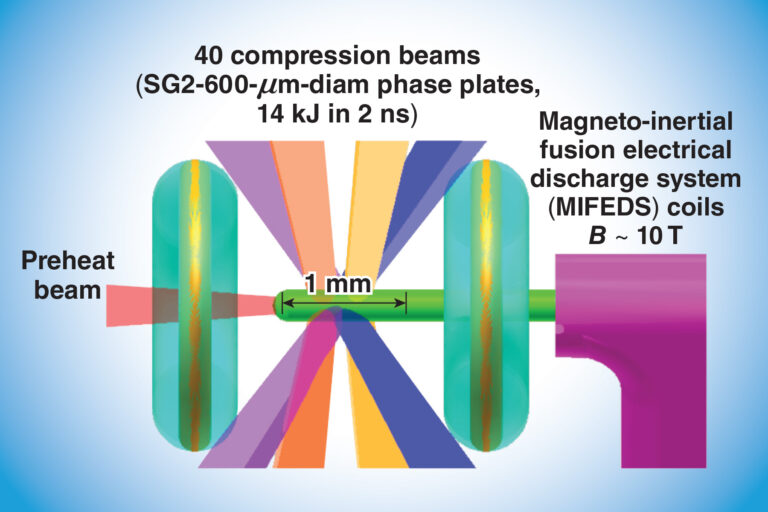
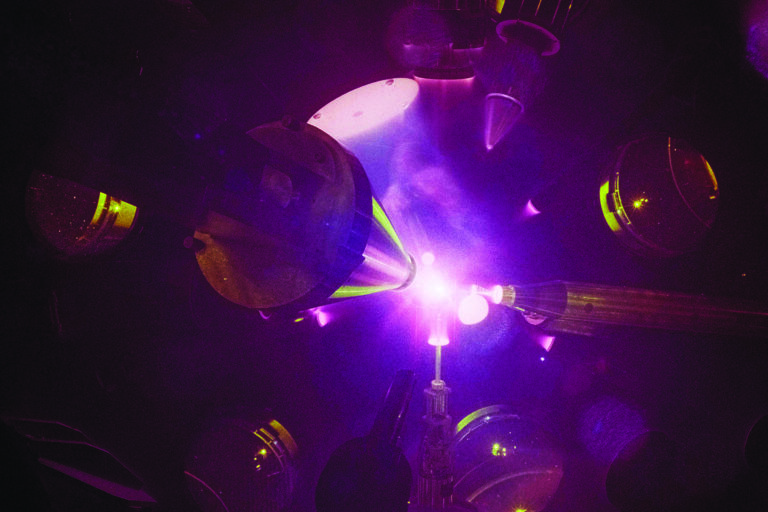
The Department of Energy’s Advanced Research Projects Agency-Energy (ARPA-E) announced a two-year, $3.8 million award for Sandia National Laboratories and the LLE to study the potential of combining two different technologies to further advance their research efforts to produce controlled fusion reactions. The award seeks to build upon the successes of Sandia’s magnetized liner inertial fusion (MagLIF) concept. MagLIF is an innovative magneto-inertial fusion concept that exploits advances in pulsed-power technology.
“The ARPA-E award will fund research that will benefit from the existing strong collaborative effort between Sandia National Laboratories and LLE,” said Professor and LLE Director Robert L. McCrory. “LLE, with its 60-beam OMEGA and four-beam high-energy OMEGA EP lasers, and Sandia, with the world’s largest pulsed-power machine, Z, provide unique capabilities to explore a range of fusion parameters previously unexplored.”
“Creating a high-output reaction in a MagLIF plasma at Z should demonstrate the promise of the broader field of research we call magneto-inertial fusion—a potentially inexpensive form of fusion,” said project lead and Sandia manager Dan Sinars. “We hope that the results of our research will motivate more efforts in this area.”
Implosions on OMEGA Exceed 50-Gbar Hot-Spot Pressures
Hot-spot pressures greater than 50 Gbar were achieved in direct-drive layered DT cryogenic implosions on OMEGA. A combination of laser and target improvements on OMEGA, as well as upgraded nuclear and x-ray diagnostics, led to the >50-Gbar observation. These experiments are part of an LLE campaign to demonstrate fuel pressures of 100 Gbar—the pressure required to demonstrate hydrodynamic equivalence on OMEGA to a direct-drive–ignition capsule at the National Ignition Facility.
Multiple-Pulse Driver Line
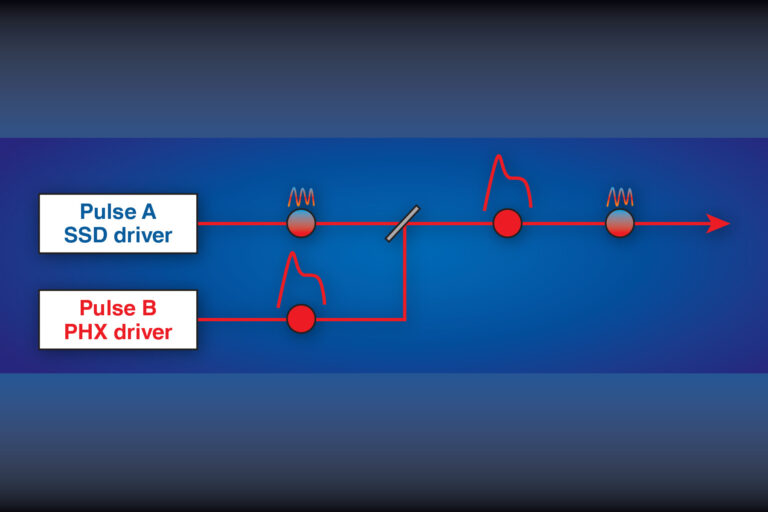
The multiple-pulse driver line (MPD) provides on-shot co-propagation of two separate pulse shapes in all 60 OMEGA beams. Smoothing by spectral dispersion (SSD) bandwidth is applied to the picket pulse shape (pulse A) generated by the SSD driver. No bandwidth is applied to the pulse generated by the Phoenix (PHX) driver (pulse B). SSD is used to prevent early-time beam imperfections from imprinting onto the target. However, there is an energy penalty associated with running SSD, the bulk of which can be recovered if SSD is not applied during the main pulse.
KBframed 16-Image X-Ray Optic
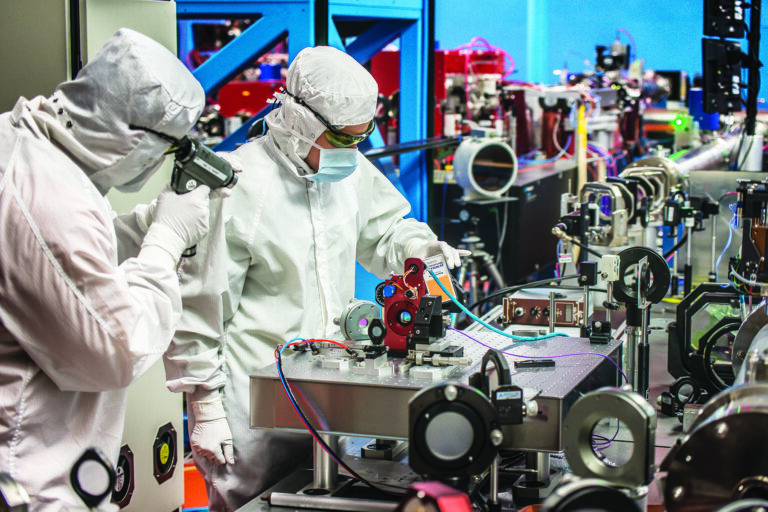
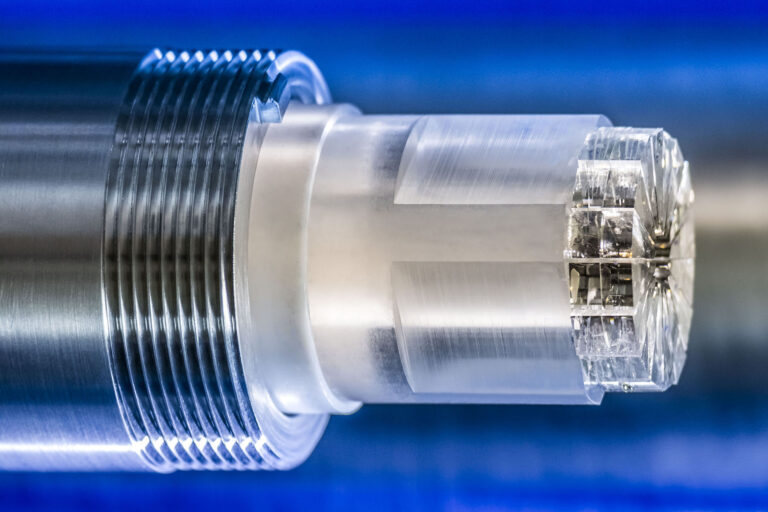
The next-generation Kirkpatrick–Baez (KB) microscope employs new x-ray optics for use on OMEGA cryogenic target implosions. Developed by Senior Scientist Frederic J. Marshall, the 16-image KB optic fits onto an existing OMEGA KB microscope chassis. The optics (seen in the right side of the image) have been arranged so that the individual images fall onto the imaging elements of a fast framing camera. The framing camera is used to time-gate the images from each optic to produce a “movie” of the late stages of a cryogenic implosion with a frame-to-frame resolution of 30 ps. The compact mirrors have a demonstrated spatial resolution of ~5 μm. This unique combination of spatial and temporal resolution is an important addition to the diagnostic arsenal at LLE. The measurements from this new KB microscope will be used to infer the central pressure achieved in the cryogenic implosions, a key performance metric in establishing DT fusion ignition equivalence with the OMEGA laser.