Timeline – 2002
Simulation of Shock Propagation Through Foam
The plot shows the density of a shock propagating through a foam, simulated by the adaptive-mesh refinement code AMRCLAW, in collaboration with Adam Frank and Alexei Poludnenko of the University of Rochester’s Department of Physics & Astronomy. The work is studying the effects of porosity on shock timing for wetted-foam layers relevant to OMEGA and National Ignition Facility (NIF) target designs.
Designs for Direct-Drive Ignition Experiments on the NIF
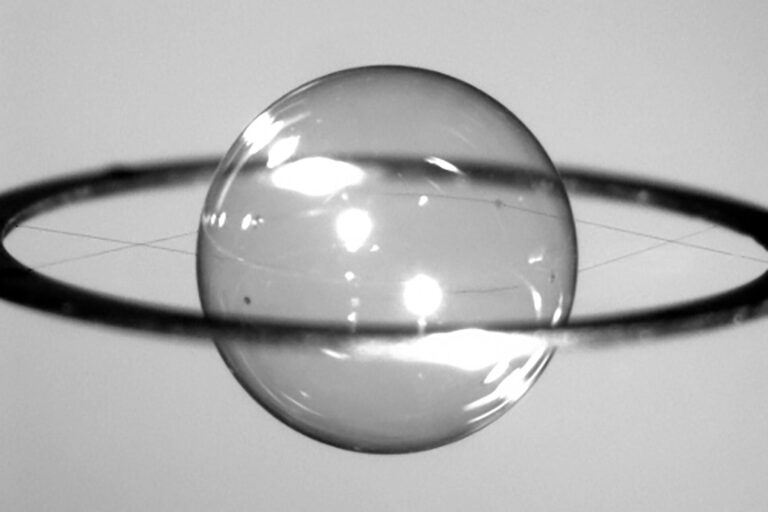
LLE scientists made significant progress in developing experimental designs for direct-drive–ignition experiments on the NIF. Their 2002 work indicated that it may be possible to carry out high-performance, direct-drive implosions on the NIF using the x-ray-drive beam configuration. In preparation for future direct-drive experiments on the NIF, a NIF-scale prototype target assembly was demonstrated at LLE. A 3.175-mm-diam spherical target was mounted onto a 125-μm-thick, 7.34-mm-outside-diam Ti ring using four spider-silk strands. The target assembly had a resonant frequency of 125 Hz and was compatible with the NIF target chamber geometry.
New Planar Cryo Target Positioner
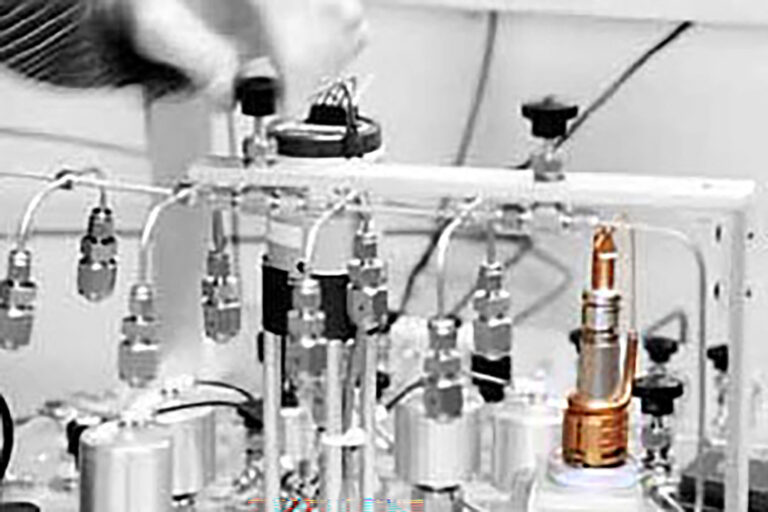
A new target positioner (planar cryo) was deployed on OMEGA to measure the properties of condensed gasses at cryogenic temperatures. It used a closed-loop cooling system that is fully compatible with the infrastructure developed for spherical cryogenic targets. A single planar cryogenic system can field one target every two hours.
Optical Parametric Chirped-Pulse Amplification
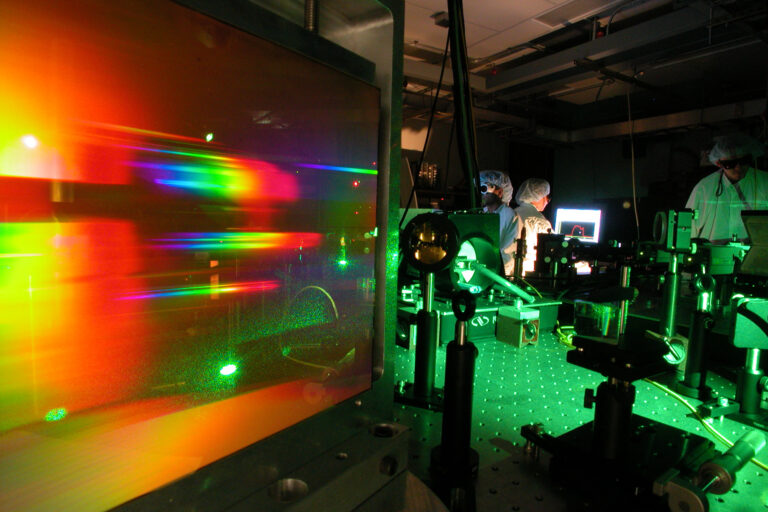
A key element of future ultrahigh-intensity lasers is a stable, high-efficiency laser source capable of generating broad-bandwidth pulses that can be amplified by a high-power amplifier system. Optical parametric chirped-pulse amplification (OPCPA) is a novel laser concept that is well suited for this application. LLE’s OPCPA system demonstrates one of the highest efficiencies for such systems currently available in 2002. The OPCPA concept is based in part on an LLE-invented concept: chirped-pulse amplification (CPA). The CPA idea created a revolution in laser technology by enabling the development of ultrahigh-intensity [i.e., >1015 W (petawatt)] lasers.
Deformable Mirror Assembly
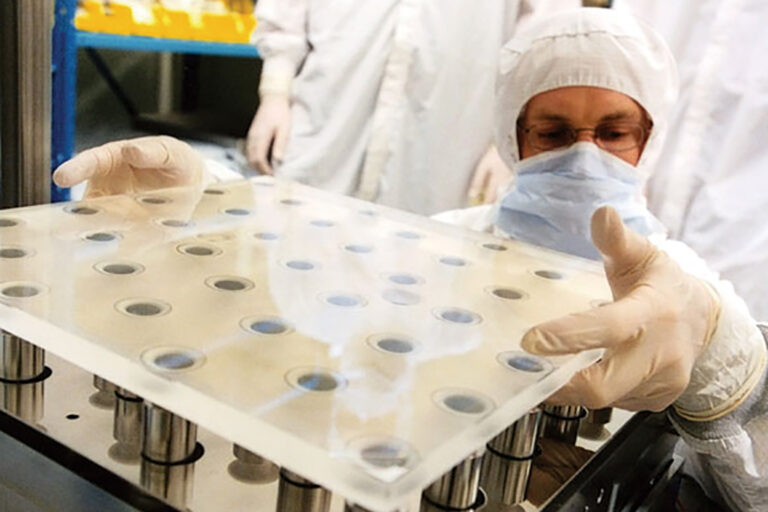
LLE is contracted to coat, assemble, and acceptance test deformable mirrors for use on the National Ignition Facility (NIF). LLE’s Optical Manufacturing Group optimizes a low-stress, high-reflectance coating process for the deformable mirror faceplate and has developed an aluminum coating that protects the epoxied post and transducer joint from flash-lamp radiation.
Each deformable mirror includes 39 actuators sandwiched between a coated glass faceplate and a metal reaction block. As the wavefront control system detects beam aberrations, information is sent to the metal reaction block. The actuators push against the reaction block to move the faceplate mirror surface and correct errors in the beam.