


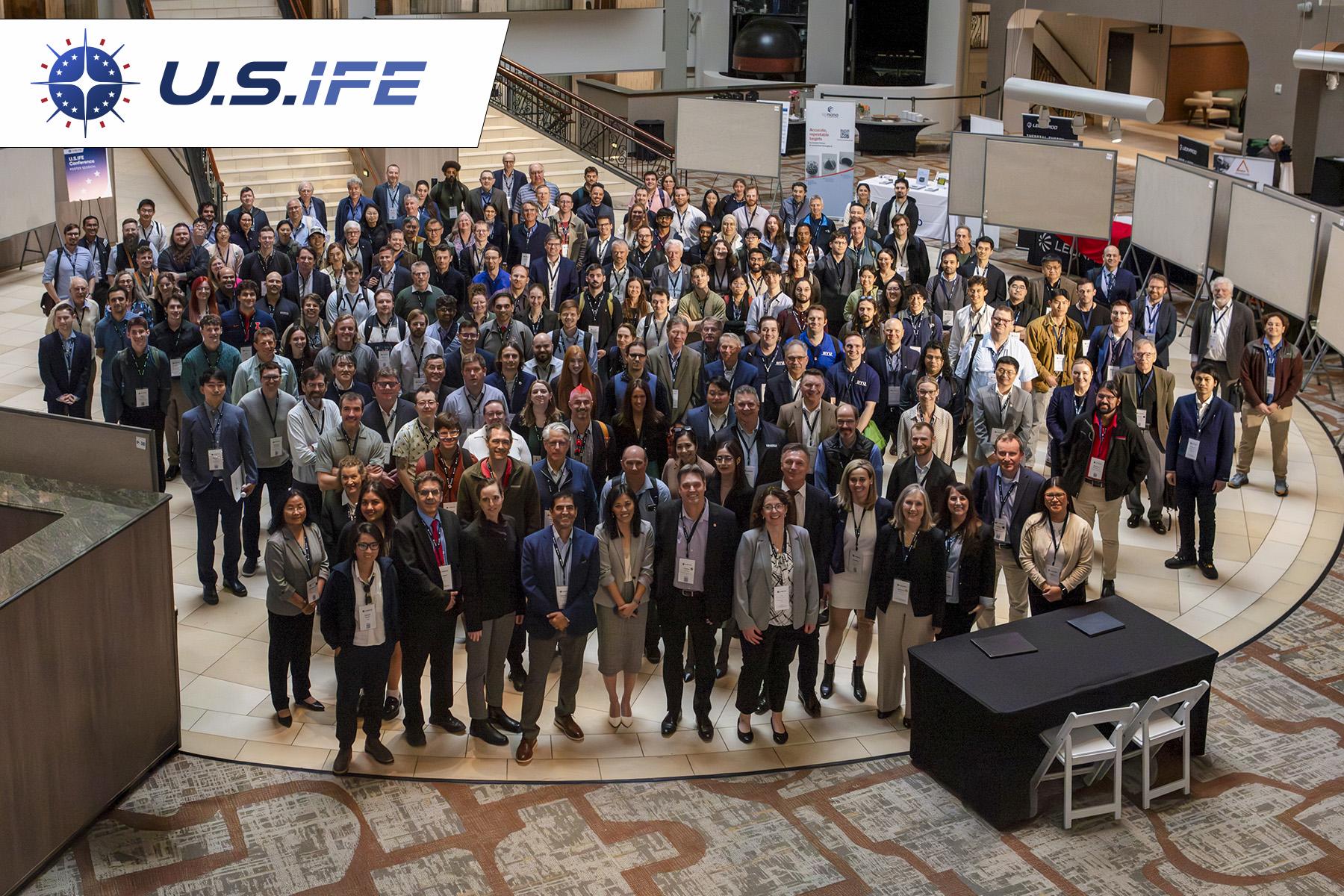
More than 225 members of the US inertial fusion energy (IFE) community gathered in the Washington, DC, area on March 22–27 for the second annual US IFE Conference, formerly IFE-STAR. Organized through LLE and held at the Hilton DC/Rockville hotel, the week combined a rigorous technical program with a focus on building the cross-institutional relationships the field will need as it scales.
The conference opened with US Department of Energy (DOE) leaders Jean Paul Allain, inaugural Director of the Office of Fusion, and Kramer Akli, Fusion Energy Sciences Program Manager, who outlined current US fusion strategy and mapped the evolving IFE ecosystem. Nine national laboratories contributed talks across a program spanning target physics, theory and simulation, AI and machine learning, driver development, systems engineering, and fusion materials—a breadth that reflects the field’s shift toward the engineering demands of a working power plant. Universities presented topics ranging from final optics design to open-source chamber modeling to the societal dimensions of fusion deployment. A single session brought all three DOE-funded research hubs—STARFIRE, IFE-COLoR, and RISE—together for their halfway-mark reports, offering a clear picture of how the national IFE program fits together.
Private industry also presented technical sessions, with major IFE companies sharing progress on pilot-plant design, high-repetition-rate target systems, and fuel cycle development. International contributions addressed industrialization pathways and large-scale experimental infrastructure.
“Most conferences focus on one area: target physics, drivers, or materials,” said Dustin Froula, principal investigator for the IFE-COLoR hub at LLE and chair of the conference organizing committee. “This one brings the entire community together. The science is no longer the only question, and the path to a power plant is starting to come into focus.”
Student and early-career researchers were central to the week. A graduate student poster slam featured participants delivering two-slide presentations in three minutes before continuing their conversations at the poster sessions that followed. Across these sessions, more than 100 posters were presented, drawing contributors from across the US and international partners, covering the full spectrum of IFE research from target fabrication and plasma physics to chamber modeling and workforce development. Eleven students, from the high school to graduate level, were recognized for outstanding research contributions.
The next US IFE Conference will return to Washington, DC, in 2027.