


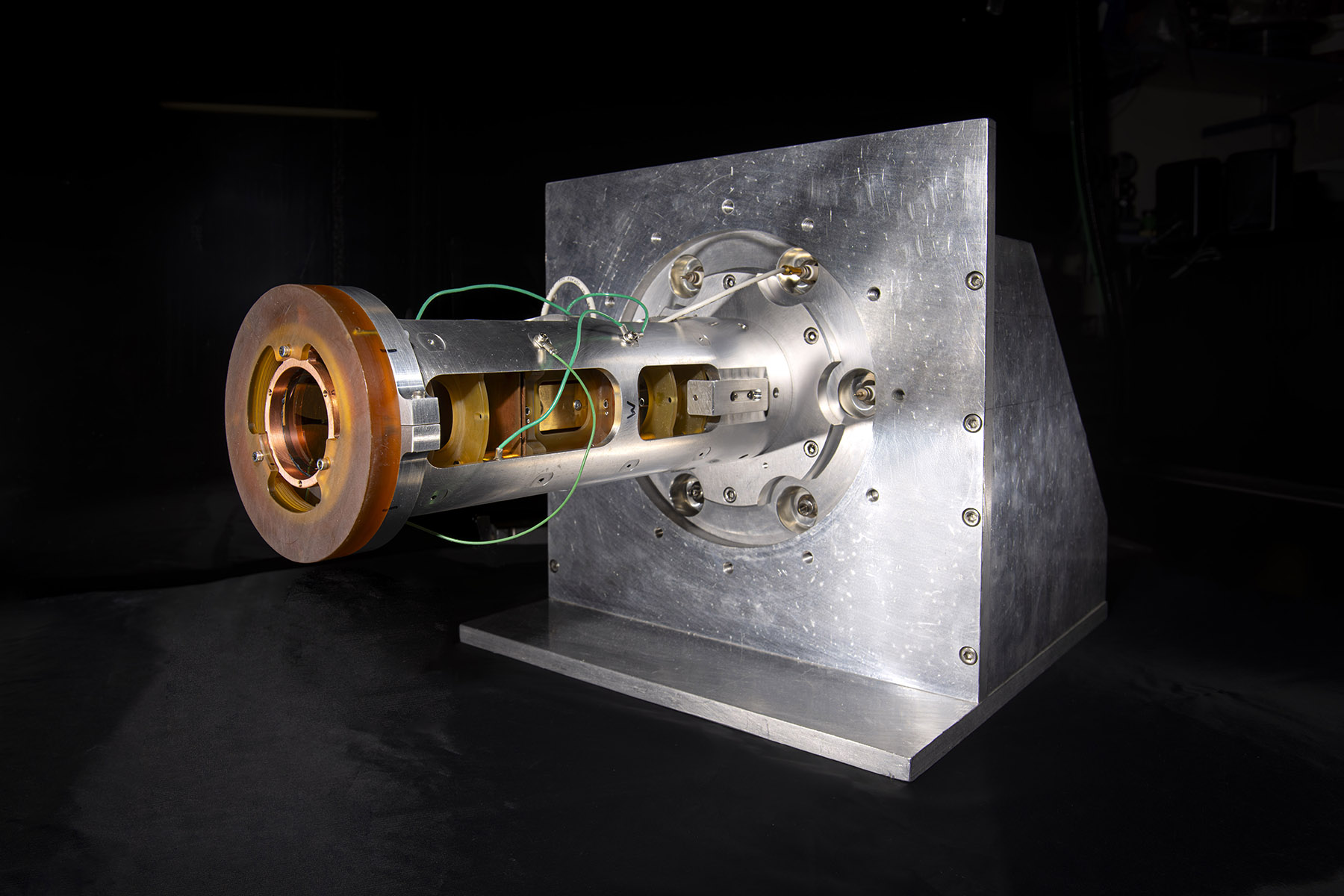
Over the last several years, scientists and engineers at LLE have been developing the BHx streak tube, a cutting-edge instrument designed to capture changes in light on a trillionth-of-a-second timescale. LLE and the high-energy-density (HED) community generally rely on streak tubes for a variety of measurements, the most demanding of which is ultrafast x-ray spectroscopy. Streak-camera technology has struggled to keep up with experimental demands, and innovation has slowed significantly, causing concerns over facility sustainment and the ability to validate atomic physics models that fusion scientists rely on to design and interpret experiments.
The BHx aims to deliver higher signal levels over larger detection areas with finer resolution using an innovative electron-optical design pioneered at LLE. This work will not only improve the quality of the data for today’s experiments—it will lay the foundation for the next generation of streak cameras and sustain critical competencies at LLE in ultrafast diagnostics for decades to come.
Streak Tubes and Their Applications
Many laser–matter interactions evolve on picosecond (10–12 s) timescales. For example, the heating of electrons by an intense laser pulse, the onset of relativistic self-focusing, and the growth of plasma instabilities can all occur within a few picoseconds. In HED experiments, these dynamics govern energy deposition, hot-spot formation, and the evolution of shock fronts, making picosecond-resolved diagnostics essential for understanding and optimizing inertial confinement fusion implosions.
In these interactions and over these timescales, valuable information is carried by photons that escape from the plasma. As liberated electrons interact and recombine with ions, x rays are released. The energy spectra of these x rays feature peaks and continua that are affected by the local density, temperature, composition, and charge state of the plasma. In this way, time-resolved emission spectroscopy offers insight into the complex landscape of HED-relevant plasma conditions.
These x rays can be collected and dispersed by their wavelength via diffraction from a crystal lattice. Registering the temporal dynamics of this spectrum over trillionths of a second proves challenging since suitably fast x-ray charge-coupled devices (CCDs) or framing cameras do not exist. X-ray diodes can exhibit picosecond-scale resolution, but stacking them with sufficient density to capture the spatial variations of interest within a spectrum proves infeasible.
First developed in the 1950s by adapting technologies from photomultiplier tubes, electron microscopy, and high-voltage pulsed electronics, streak tubes address the challenge of detecting ultrafast temporal changes in a spatially resolved signal by converting time variation into variation over space that can be recorded. While photons can be manipulated with conventional optics, it is difficult to measure their subpicosecond variations directly. The first step in a streak tube is to convert photons to electrons—negatively charged particles that can be precisely deflected and controlled with electromagnetic fields. Relying on the photoelectric effect, a photocathode converts spatial and temporal variations in the light signal into equivalent spatial and temporal variations in emitted electrons.
Under vacuum, a streak tube accelerates photocathode electrons to kilovolt energies and manipulates them using a series of electrodes to form a reproduction of the original image on a final detector with high resolution. The temporal resolution of the streak tube arises from deflecting the electrons with time-varying voltages applied across two deflection plates. This produces a 2D image on the detector: one dimension captures the spatial variation of the original light intensity; the other dimension represents its temporal variation. With carefully designed electrodes, such a system can capture detailed spatial information and its variation on picosecond or subpicosecond timescales.
This technology uniquely enables ultrafast x-ray spectroscopy, but it is also useful in many other contexts. Indeed, streak tubes are relied upon at LLE for time-resolved Thomson scattering and absorption measurements, as well as for measuring laser beam power over time. In each case, the signal of interest is a 1D distribution over space: either a spectrum, a slice of an image formed by a pinhole camera, or a series of linearly spaced laser beams.
Limitations in Streak-Tube Technology
The earliest streak tubes were developed with a combination of intuition, trial and error, and practical engineering compromises, without the benefit of rigorous modeling or predictive design tools. Modern computing power was not available to their designers, making it all the more impressive that they were able to build and refine these into instruments that met many of their original needs and continue to be used successfully today in certain applications. The needs of plasma physicists have outpaced the rate at which streak-tube technology has advanced, leaving insufficient resolution, signal level, and photocathode size to validate modern atomic physics models.
Today, computers enable the sophisticated and rapid modeling of electrode-generated fields and the propagation of charged particles by applying finite-element methods. In traditional optics, increased computing power allowed the design of photolithographic lens systems with dozens of elements, maximizing the numerical aperture while minimizing aberrations—ushering in the modern semiconductor era. A similar transformation is now possible in electron-optical design, as demonstrated by the BHx streak tube.
Because the streak-tube user base is relatively small, limited commercial incentive exists for innovation. Successful research and development efforts can lead to industry partners manufacturing and servicing the instruments, as seen with the Rochester Optical Streak System (ROSS) line of streak cameras. This makes partnerships between research laboratories, academia, and industry essential.
The BHx Design: What’s Different?
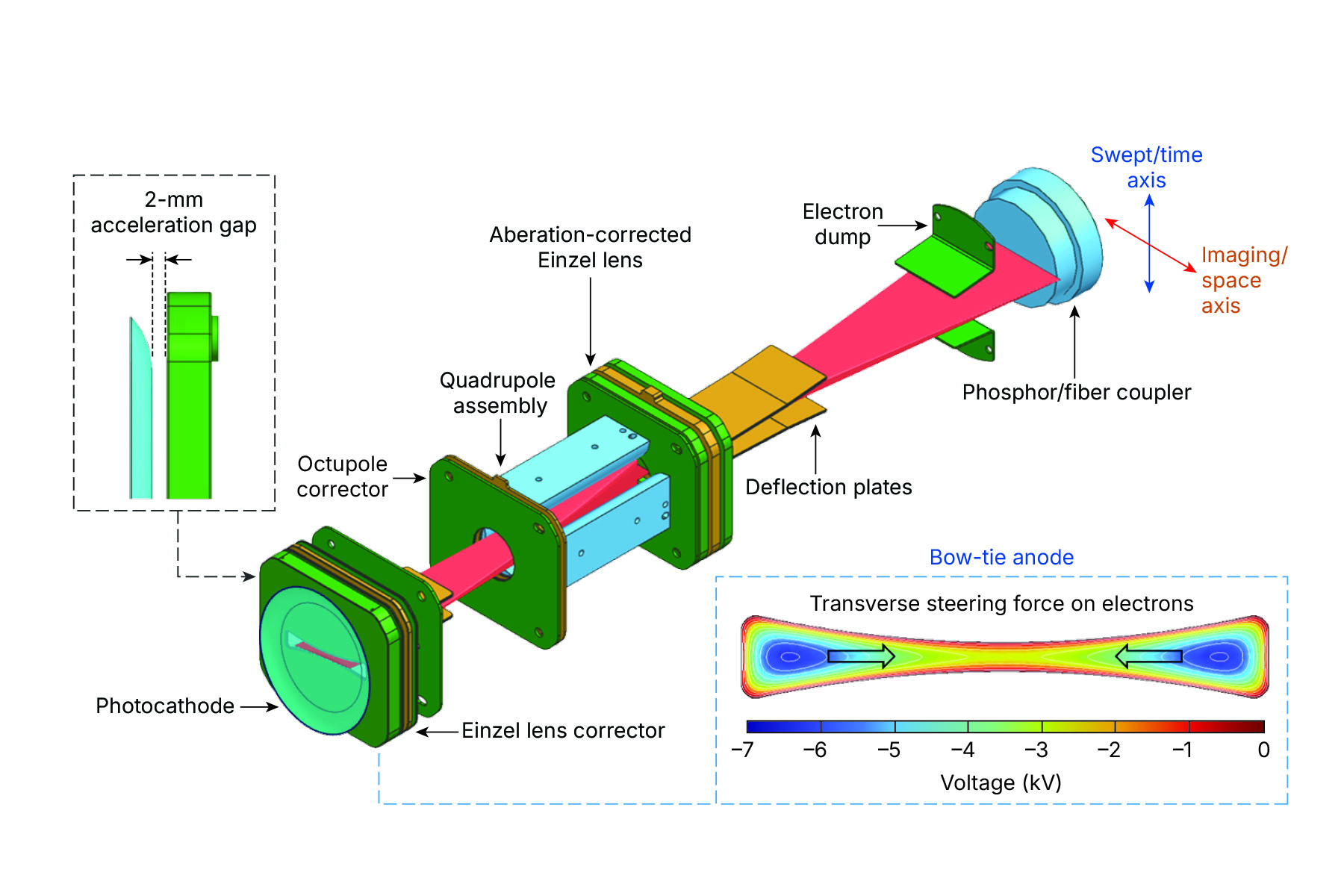
To address limitations found with existing instruments, the BHx streak tube, shown schematically in Fig. 1, was designed to provide subpicosecond temporal resolution with a 25-mm photocathode, a 70% maximum internal photoelectron throughput, and 2000 spatial-resolution elements.
Compared to the PJX3 streak camera, which is frequently used for ultrafast x-ray spectroscopy at LLE, the BHx is expected to exhibit a signal level and photocathode size that are several times higher and several times larger, respectively, while operating with higher temporal resolution.
The BHx was designed to accomplish this by implementing a sophisticated electron-optics layout refined over many years using modern electron-tracing software tools. It does this all in a smaller package than the PJX3 streak camera, ensuring compatibility with the ten-inch manipulator (TIM) platform used on the Omega Laser Facility. Additionally, the BHx tube uses two new features: a bow-tie profile slot anode and an aberration-compensating final focusing electrode enabled with the inclusion of an in-line conductive grid.
Bow-Tie Anode
The acceleration stage of a streak tube is responsible for light-to-electron conversion, the acceleration of the electrons to full energy, and for directing these electrons into the subsequent electron optics. The acceleration potential is formed in conjunction with the photocathode by either an extraction mesh or with a slot anode (a metal plate with a rectangular opening). In both scenarios, the electrons exit the acceleration stage either collimated or weakly divergent—large photocathode areas would require prohibitively large downstream electrodes to accept all of the electrons. The PJX3 tube solves this by using a large concave photocathode that naturally steers the electrons inward into the quadrupole assembly while keeping its form factor minimal. As is often the case in electron optics, solving this problem creates a new one: the curved photocathode introduces challenges in imaging at the detector plane, necessitating a curved final detector and resulting in significant imaging distortions.
The BHx enables a large photocathode without the need for either making it concave or for a large subsequent electrode by using a variant on the traditional rectangular slot-anode extractor. By making this aperture bow-tie shaped instead of rectangular, the electric-field structure set up within the extractor steers the electrons inward. This simple innovation enables the use of a flat, 25-mm photocathode without the drawbacks or compromises associated with other streak-tube designs. It also enables a flat detector surface, leaving open the possibility of direct electron writing to a CCD rather than using a phosphor, which could further improve resolution.
Aberration-Compensating Electron Lens
In many streak-tube designs, aberrations accumulate from multiple electron lenses in the system that heavily degrade focusing at the detector plane, limiting both spatial and temporal resolution. To improve the resolution to acceptable levels, a common approach is to strongly aperture the electron beam at the exit of the final focusing lens. Eliminating off-axis electron trajectories improves focusing at the expense of signal levels—similar to squinting one’s eyes to better read a chalkboard. The final focusing lens in the BHx streak tube employs an in-line conductive grid that modifies the field structure to reduce spherical aberrations accumulated in the system, allowing for larger throughput with high resolution.
Progress and Results
The BHx concept is the result of decades of cumulative experience involving various streak-tube designs, combining proven elements with new concepts tested through extensive computer modeling. A mechanical design derived from the computer model has come to life in a prototype streak tube. Over the last three years, the BHx team has been working to assess the real performance of this device against model predictions. In the process, they have made several improvements to both the mechanical and electron-optics designs.
While the ultimate application of the instrument is for use with x rays, early testing used a UV laser source due to its high repetition rate and the ease of assessing focusing performance of the tube. The UV laser illuminated a standard resolution target that could be optically relayed onto the photocathode surface. In this way, challenging optical patterns were presented to the photocathode and the BHx tube was evaluated by how well it could reproduce the image with electrons at the final detector.
Assessing tube performance statically, rather than dynamically, also simplified testing. This involved applying a series of static voltages to the plates and recording data at each step, rather than a time-varying voltage to the deflection plates to sweep the electrons across the detector. Simulations were run to mimic these conditions (a UV light source and static deflection), and the tube voltages were optimized via lengthy, automated scans to identify the best focused performance.
Ongoing Simulation Efforts
Simulations play a pivotal role in the BHx development effort, extending well beyond the initial design phase. Beyond supporting the development of complex electron-optical systems, they guide data interpretation, predict performance across varying experimental conditions, anticipate issues before they arise in the laboratory, and inform hardware revisions. These predictive capabilities prove essential for reducing experimental uncertainty and accelerating development.
The current simulation toolkit combines the particle-tracing code simion with complementary data from COMSOL Multiphysics modeling. This integrated approach enables the team to analyze challenges that occur at fast sweep speeds and evaluate potential mitigation strategies. Simulations also support detailed tolerance studies, providing quantitative insight into how fabrication and alignment tolerances affect overall system performance.
Building and Sustaining Expertise
The BHx project has drawn on expertise from a wide range of disciplines, including mechanical and electrical engineering, electron optics, traditional optics, laboratory automation, and materials physics. A long history of developing, upgrading, and maintaining complex diagnostic instruments, coupled with the concentration of relevant expertise at LLE, provides a strong foundation for advancing streak-tube technology. The BHx team benefits from regular consultation with experienced diagnostic engineers and specialists in these specific fields. Complete ownership of the design and development of the instrument also strengthens the ability at LLE to spin off and field variant instruments for specific use cases.
In addition to advancing the technical design, the project has served as an important vehicle for knowledge transfer, ensuring that expertise in streak-tube development, characterization, and operation is preserved and expanded within LLE.
Buried-layer experiments on the MTW-OPAL Laser System in FY27–28 mark the first planned use for a BHx-based streak camera. The combination of high photoelectron throughput, subpicosecond resolution, and a large, active photocathode area will provide high-fidelity measurements from materials heated to high-energy-density states, allowing for the detailed interrogation of atomic physics models relied upon for inertial confinement fusion efforts.
Corresponding author: A. E. Raymond