


Researchers at LLE and The Ohio State University (OSU) have teamed together to develop renewable, liquid crystal plasma mirrors (LCPMs) to enhance the temporal contrast of the 25-PW pulses planned for NSF OPAL. High-peak-power lasers often deliver unwanted energy, known as a “prepulse,” that precedes the desired ultrashort pulses. Given the extremely high peak powers of the main pulse, these prepulses can disrupt experiments even when they are much smaller than the main pulses.
Liquid crystals (LCs) are an innovative way to create renewable plasma mirror films. This approach was first demonstrated at OSU [1], where an LC compound was wiped across an open aperture to create ultrathin (<30-nm), freestanding films similar to a soap bubble. These LC films demonstrated 80% reflectance at 2 × 10¹⁶ W/cm2 [2], which is comparable to conventional plasma mirrors. Repeatably wiping a new LC film proves to be a highly cost-effective (<$0.01 per shot) and straightforward approach.
NSF OPAL will require large LC film diameters (~15 mm) that are optically flat (λ/10 or better) to maintain good focusing quality. Inherently, nonuniformities occur where the LC fluid meets the edge of the physical aperture, which reduces the usable portion of the film. A prototype device with 24-mm-diam films of 8CB (the LC material used in early LCPMs) shows promise for supporting up to 4-PW beams, so a proposed experiment at the 3-PW NSF ZEUS Laser Facility aims to test the device. However, the 24-mm LCPM does not satisfy NSF OPAL film uniformity requirements, so the OSU–LLE team has built on the >40 years of LLE experience with LC materials for laser applications to explore new approaches.
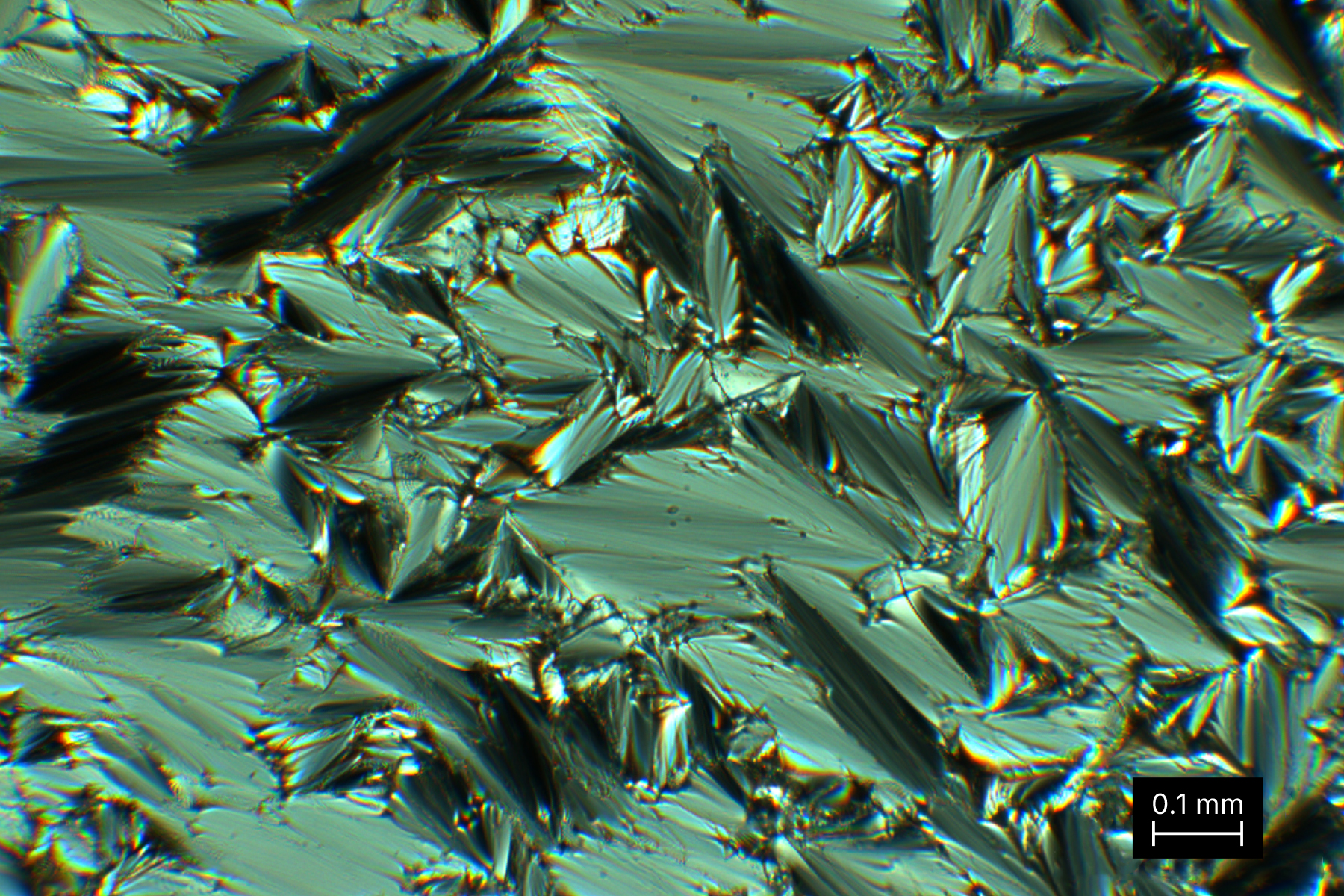
Mixtures of LC molecules can enable the fine-tuning of material properties, much as metal alloys can improve upon pure metals. Over the past year, the LLE Optical Materials Group, including several student researchers, studied the physical properties of a wide variety of LC mixtures along with their temperature dependencies. Polarized optical microscopy imaging enabled LLE researchers to understand the crystalline nature of the mixtures and the temperatures required for forming high-quality films. One formulation using a cyanobicyclohexyl compound, known as CCH-2, performed exceptionally well in combination with 8CB. This mixture repeatably demonstrated a 75% improvement in uniformity as compared to 8CB films of the same aperture size. This breakthrough is expected to provide the uniformity needed for NSF OPAL and other multipetawatt laser systems.
Corresponding author: N. D. Urban