


Current Status of Inertial Confinement Fusion Research
December 5, 2022, marked a major milestone for humankind. On this day, a team led by Lawrence Livermore National Laboratory (LLNL) used the world’s most powerful laser at the National Ignition Facility (NIF) to compress a mixture of deuterium and tritium (DT) to conditions in which the energy produced by fusion reactions exceeded the laser energy used in the experiment. In other words, ignition was achieved.
Fusion reactions themselves are not exotic: they power the Sun and occur during star formation throughout the universe, naturally taking place on vast scales in systems with enormous energies. On Earth, significant fusion energy release has also been observed, most notably in thermonuclear weapons. However, even these are far too energetic to be controlled in a laboratory setting.
A distinctive feature of the LLNL experiments is their extremely small scale. The team used just 0.22 mg of DT fuel contained in a target roughly the size of the head of a matchstick. With a laser input of 2.05 MJ, approximately the amount of energy required to bring two gallons of water to a boil, the experiment produced 3.1 MJ of fusion energy, satisfying the National Academy of Sciences’ definition of ignition. The fuel was compressed using the inertial confinement fusion (ICF) approach, in which lasers drive the implosion of the target. You can read more about this groundbreaking experiment in the article, “Lawson Criterion for Ignition Exceeded in an Inertial Fusion Experiment,” published in Physical Review Letters [1].
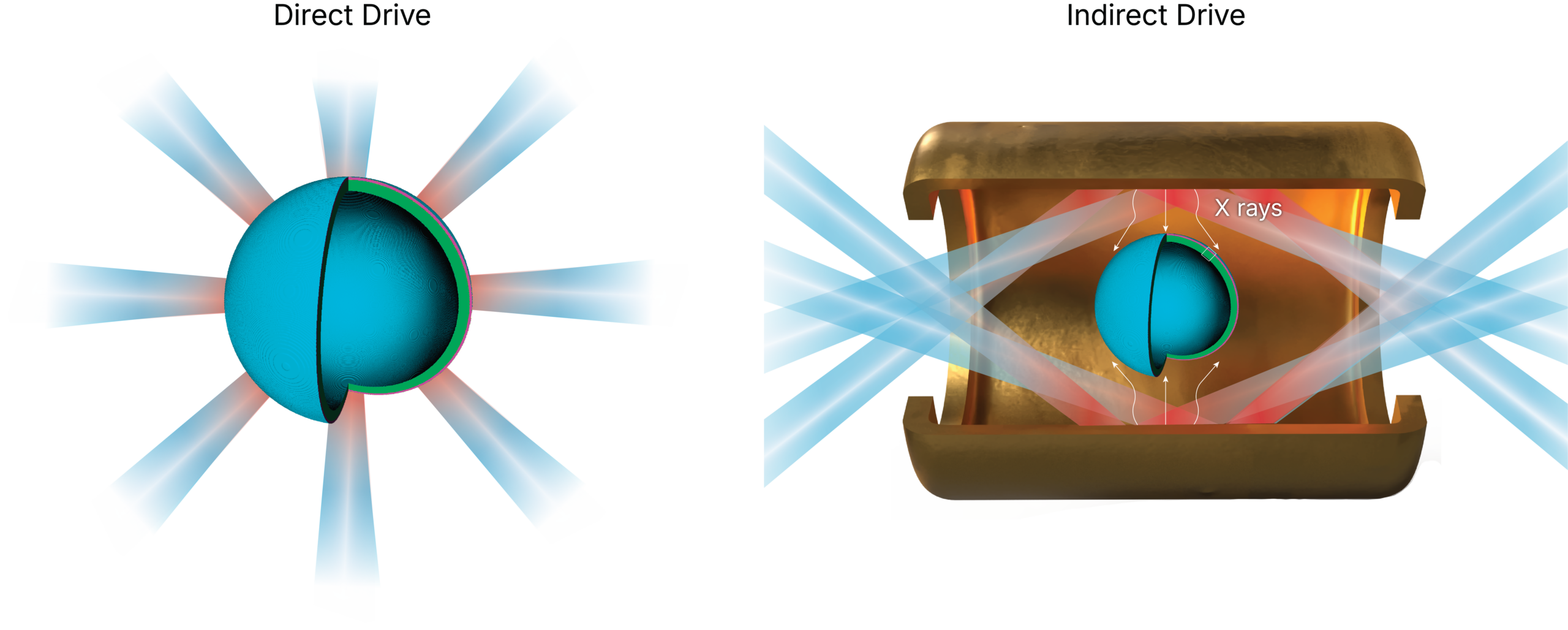
ICF shares many similarities with a conventional combustion engine. To achieve ignition in an ICF experiment, one must first compress the DT fuel—analogous to the compression of gasoline vapor by a piston in an engine. In ICF, compression is achieved either through direct laser irradiation of the target (direct drive) or by x rays (indirect drive) generated by converting laser light inside an enclosure made of metal with high x-ray production efficiency (e.g., gold). Such laser or x-ray irradiation ablates the target material, generating a rocket-like effect that drives the inward compression of the DT fuel. The fundamentals of ICF are outlined in detail in LLE In Focus, Issue 2.
After the fuel is compressed, it is ignited by a spark. In a combustion engine, this spark is produced by a spark plug, but in ICF, the spark is formed in a central region of high-temperature (~20 million degrees) DT plasma known as the “hot spot.” These conditions are created as the surrounding shell of higher-density fuel compresses the lower-density region in the target center. For ignition to occur, a key condition known as the Lawson criterion must be satisfied—essentially, the heating rate of the plasma in the central region must exceed its cooling rate.
Reaching ignition on the NIF is a remarkable achievement because igniting the small amounts of DT fuel in a laboratory setting is extremely challenging. The success of the NIF campaign was built on more than 70 years of research conducted at numerous facilities worldwide. It also required the ingenuity and expertise of scientists and engineers at the scale of a national laboratory, working with the world’s largest laser for over a decade to reach this milestone.
Why is achieving ignition in a laboratory so difficult? One reason is the extremely small scale of the igniting plasma. Although the NIF facility spans the area of three football fields, the burning plasma generated in an experiment measures only about 80 μm in diameter—roughly the width of a strand of human hair. What limits the plasma size? The short answer is the available energy.
Taking a deeper look, we can invoke the ignition criterion, which in its simplest form can be expressed in terms of the hot-spot energy and size. Why, then, is the plasma size so much smaller in the NIF experiment?
To answer this question, it is important to understand that one of the main limitations of ICF is its low efficiency in coupling laser energy to a hot-spot plasma. Several factors contribute to this. As an example, let us consider the indirect-drive approach, where laser energy is first converted into x rays inside a gold can (hohlraum). This conversion is only about 20% efficient. The x rays then heat the target, driving mass ablation from its surface. The ablated material generates a force, analogous to rocket thrust, which is also only ~10% efficient. So, the fuel gets only a small percent of incident laser energy. Finally, at peak compression, roughly 30% of the energy coupled to the fuel reaches the hot spot. Despite the world’s largest laser delivering 2 MJ of energy, the hot spot gets only ~7 kJ.
The other challenge of ICF is that the target needs to be accelerated inward to an extreme velocity. Indeed, containing 7 kJ of energy inside a ball 80 μm in diameter is equivalent to a plasma pressure of 300 Gbar or 300 billion atmospheres, which is very similar to the conditions inside the Sun—and not surprising since fusion is the very process that powers the Sun! Squeezing energy into a tiny volume requires accelerating the targets to extremely high velocities, above 300 km/s, or nearly 1 million miles per hour. This velocity is over 30 times faster than the escape velocity of a rocket traveling to outer space.
The timescale in ICF is equally extreme. The implosion time is set by the ablation pressure generated in the ICF “rocket.” The resulting ablation pressure acts on the target surface, providing the accelerating force. If the pressure is high, the target gains its energy by this force acting over a shorter distance; if it is lower, the target must be accelerated over a much longer distance.
In a typical indirect-drive implosion, the ablation pressure is of the order of 150 Mbar (150 million atmospheres, or 100 times more than what is required to form diamonds inside the Earth). This pressure accelerates the target to ~300 km/s over a distance of ~1 mm. Therefore, the corresponding implosion time—and thus the laser pulse duration—is only ~5 ns. This is an extraordinarily short time: in 5 ns, light barely travels your own height.
One of the greatest challenges the LLNL team needed to overcome in demonstrating ignition on the NIF was maintaining the target’s spherical symmetry throughout the compression. Since the initial target diameter is ~1 mm, and the size of burning plasma 80 μm in diameter, the fuel must converge by a factor of 25 during an implosion. At such extreme convergence—in which the volume changes by a factor of 25³, or 15,625—target imperfections, drive asymmetries, and the effects of target mounts are amplified by hydrodynamic instabilities such as the Rayleigh–Taylor instability (RTI). The instability growth can disrupt the shell, preventing it from reaching ignition conditions.
The Role of Direct Drive in the Quest for High Yield
Following the achievement of ignition, the key challenge becomes reaching the ultimate goal of ICF: producing high yields of the order of several hundreds of MJ. In current ignition experiments on the NIF, the relatively small hot-spot energy (~7 kJ) constrains the hot-spot diameter to about 80 μm. This results in extremely high energy densities, or pressures, within the hot spot. Such high pressures (exceeding 300 billion atmospheres) can be attained only in designs with shell velocities above 350 km/s. NIF ignition experiments reached implosion velocities of ≃390 km/s to compensate for performance losses due to shell asymmetries.
High shell velocities have two key implications for the design. First, they limit the amount of DT fuel that can be carried in the shell since heavier shells are harder to accelerate; the reduced fuel mass, in turn, constrains the achievable fusion yield. Second, high velocities compromise shell stability: a lower shell mass leads to a thinner shell that is more vulnerable to breakup from instability growth.
To address the shell stability problem, the LLNL team adopted an approach that increases shell thickness and mitigates instability growth by adding heat and raising the shell temperature. This was achieved by strengthening the first shock launched at the beginning of the implosion. In indirect-drive implosions with carbon ablators, a sufficiently strong first shock is also required to melt the carbon, thereby eliminating its granular microstructure, which would otherwise provide additional seeds for RTI growth.
The improved stability obtained through enhanced fuel heating, however, comes at the cost of reduced fuel compressibility. Higher fuel temperatures make it more difficult to compress the fuel to high densities. As a result, lower fuel densities in current ignition experiments lead to faster disassembly of the fuel after ignition conditions are reached, which result in shorter confinement times. This, in turn, reduces the burn temperature and decreases the fraction of the fuel that participates in fusion reactions.
Taken together, these limitations of current ignition experiments on the NIF point to an obvious conclusion: achieving robust ignition and higher fusion yields require coupling more energy to the fuel.
The advantages of increased fuel energy in ICF designs can be summarized as follows:
- Higher fuel energy leads to a larger “spark” region (hot spot), thereby lowering the required hot-spot pressure
- Reduced hot-spot pressure relaxes the need for extremely high shell velocities
- Reducing the velocity requirement allows for thicker shells with greater fuel mass to be used in the target design
- Thicker shells are less susceptible to the growth of nonuniformities during implosion, reducing the need for shell preheating by the initial shock
- Lower fuel temperature enhances compressibility, resulting in a higher fuel burn fraction
In short, increasing the fuel energy provides a direct pathway to robust higher yields by enabling greater fuel mass in the target and increasing the fraction of fuel that participates in fusion reactions.
To increase fuel energy, the LLNL team is currently pursuing an “extended yield capability” project, which aims to increase the laser energy from the current level of 2.2 MJ to 2.6 MJ for achieving yields of tens of megajoules. Looking further ahead, plans for a next-generation high-energy-density facility envision increasing the laser energy to as much as 10 MJ to reach the ultimate goal of hundreds of megajoules.
The direct-drive approach provides a highly attractive pathway for substantially increasing the energy delivered to the fuel. Its principal advantage is the elimination of the energetically costly conversion of laser light into x rays. As discussed earlier, this conversion consumes a lot of the incident laser energy, leaving only 20% of the laser energy to be coupled to the target. Therefore, by directly illuminating the target with laser beams, more than 90% of the laser energy can instead be coupled to the target.
As in the indirect-drive scheme, the absorbed laser energy in direct drive ablates the target material, generating a rocket-like effect that accelerates the target inward. Although the rocket efficiency of the laser drive is lower than that of x rays—since x rays penetrate deeper into the target—direct drive can, in principle, accelerate the shell to energies up to four times higher than those achieved with indirect drive. In a direct-drive target implosion on OMEGA driven by a 30-kJ laser pulse, approximately 1 kJ of energy is coupled to the hot spot.
Given this substantially higher coupling efficiency, a natural question arises: why has ignition not yet been demonstrated with the direct-drive approach on the NIF? The short answer is that the NIF laser is not optimized for direct-drive implosions. Experience from direct-drive experiments on OMEGA and the NIF has shown over the last decade that, to fully realize the advantages of this approach, the laser must be broadband—in other words, the laser must emit light at a wide range of wavelengths. In addition, advanced beam-smoothing technologies must be incorporated into the laser system.
The broadband requirement comes from the need to mitigate deleterious laser–plasma interaction effects. As the laser propagates through the low-density blowoff plasma produced by target ablation, it excites plasma waves—similar to the way a boat generates a wake as it moves through water. These plasma waves can then interact with laser beams arriving from different directions, scattering their energy away from the target. This phenomenon is called cross-beam energy transfer, or CBET. In addition, they can accelerate plasma electrons, analogous to surfers gaining speed by riding ocean waves. These energetic electrons can travel long distances and deposit their energy in the cold fuel, increasing its temperature and thereby reducing its compressibility, as discussed earlier. More information on CBET can be found in LLE In Focus, Issue 3.
The excitation of plasma waves is a resonant process. If the laser operates at a single wavelength, plasma waves are driven resonantly at specific frequencies and locations within the plasma. In contrast, a broadband laser distributes its energy over multiple wavelengths, so each component drives waves at different frequencies and locations. This reduces the coherence and amplitude of the plasma waves, leading to significantly less laser scattering and weaker electron acceleration.
Beam smoothing is also critical for the direct-drive approach since the laser interacts with the target directly. Laser beams in ICF experiments consist of narrow, high-intensity speckles. This speckle pattern gets imprinted onto the target surface at the beginning of the target drive and is subsequently amplified by hydrodynamic instabilities (such as RTI) as the shell accelerates.
To reduce this imprinting, advanced beam-smoothing techniques are employed in laser systems. On the OMEGA laser, for example, smoothing by spectral dispersion (SSD) effectively moves the speckles on a timescale much shorter than the imprinting time, thereby reducing the initial nonuniformity. While a reduced version of SSD is also implemented on the NIF, it provides only a fraction of the smoothing required for laser direct-drive implosions.
Fusion Research at LLE in Support of the High-Yield Mission
Current research at LLE focuses on understanding the key physics of direct-drive implosions and defining the requirements for future laser facilities that can fully leverage the advantages of direct drive to achieve high yields, supporting both national security objectives and inertial fusion energy applications. In the next section, we highlight the key elements of fusion research by grouping them according to three main stages of an ICF implosion.
ICF Implosion Stages
A typical ICF implosion (both direct and indirect drive) proceeds through three main stages: (1) early time (shock propagation), (2) acceleration, and (3) deceleration and neutron production. To meet the requirement for a high-yield implosion, key implosion elements must be understood:
- Fuel heating
- Imprint
- Shell nonuniformity growth during acceleration and deceleration
- Laser coupling during acceleration
- Generation of and fuel heating by energetic electrons
- Fuel asymmetry and nonradial flow at peak compression
- Fuel areal density and temperature at peak compression
Most of these critical elements are common to both direct and indirect drive. See full article for illustrations of each implosion stage, highlighting the diagnostics used to measure or infer these key quantities.
Using OMEGA and NIF Implosions to Validate Modeling of High-Yield Designs
The detailed measurements described on pp. 12–14 help designers improve and validate the modeling of key physics phenomena of ICF implosions. For example, in comparing the OMEGA high-resolution velocimeter (OHRV) data of shock nonuniformity with the model predictions (see p. 12), enhanced nonuniformity was observed in the data. This triggered an examination of early-time interactions of the laser light with the target material. In particular, the light penetrates and deposits its energy deep into the target until the atoms of the target materials are ionized, creating an electron barrier that reflects the light from the target’s outer edge. While light travels inside the shell, it damages the shell material, introducing additional nonuniformity seeding that is observed in OHRV data. To include this effect in calculations, a model of early plasma formation has been developed and implemented in hydrodynamic codes.
Another example of how measurements feed into modeling improvements is measuring laser light absorption during shell acceleration using full-aperture backscatter stations (FABS) (see p. 13). FABS measures the color (frequency) of the laser light scattered from the target. When laser light, as with any other wave, reflects off a moving surface, its wavelength shifts due to the Doppler effect. This is similar to hearing different pitches from the sound of a race car that is moving either toward or away from you. Laser wavelength also becomes slightly longer when it reflects off an imploding target surface—that is, moving away from the source. By measuring the wavelength of the reflected laser light, a smaller-than-expected shift was observed from the imploding target. The interpretation of this deficiency in Doppler shift is that the laser light does not penetrate deeply enough and reflects earlier, prior to reaching the target surface. The light reflects from plasma waves that were launched by the laser itself due to CBET, as discussed on p. 10. This effect is responsible for 30 to 40% of light reflection from the target and a significant reduction in rocket effect and ablation pressure.
This important understanding of laser coupling limitations in direct-drive implosions led to the idea of using broadband lasers, and experiments are currently underway to understand how this technology mitigates coupling losses due to CBET. These experiments are performed using the FLUX system (Fourth-generation Laser for Ultra-broadband eXperiments). Demonstrating CBET mitigation will imply that nearly 100% of the laser energy can be coupled to the target, raising the ablation pressure to several hundred million atmospheres and making broadband technology the leading candidate for a next-generation high-energy-density implosion facility, OMEGA Next.
Although much smaller than the NIF, the facility’s main goal will be to demonstrate that all direct-drive deficiencies due to laser–plasma interactions can be eliminated via a spherical implosion, and that laser technology is ready for an at-scale implosion facility to ultimately deliver high fusion yields (>100 MJ) for NNSA program needs and future energy applications.
Corresponding authors:
V. N. Goncharov, I. V. Igumenshchev, S. T. Ivancic, and M. J. Rosenberg