How Spectral Dispersion and Timing Improve Irradiation Uniformity on OMEGA
The OMEGA Laser System is designed to deliver laser energy as uniformly as possible to a spherical target using 60 beams arranged symmetrically around the target chamber. This uniformity depends not only on beam arrangement but also on the smoothness of each individual beam. The goal is to compress the spherical target evenly from all sides. If the laser light is uneven—too intense in some places and too weak in others—the target can distort as it implodes, reducing performance and making experiments harder to interpret. OMEGA uses three techniques that work together to smooth each laser beam:
- Distributed phase plates (DPPs), which split each beam into many small beamlets that overlap on the target
- Distributed polarization rotators (DPRs), which create overlapping speckle patterns with different polarizations that average together
- Smoothing by spectral dispersion (SSD), which rapidly moves the speckle pattern during the laser pulse
While all three smoothing techniques are important, SSD plays a unique role because it actively moves the laser speckle pattern during the pulse. Together, these methods ensure that the target receives a very smooth time-averaged intensity, even though the beam is not perfectly uniform at any instant. This smooth illumination is essential for symmetric inertial confinement fusion (ICF) implosions.
How SSD Works
SSD works by modulating the laser wavelength at high speed. Like light passing through a prism, each spectral component travels through the laser system at a slightly different angle. As the wavelength shifts back and forth, the beam traces a repeating pattern on the target known as a Lissajous pattern. At any one moment, the beam still has a speckle pattern, but because the pattern is moving rapidly, the target responds to a much smoother average intensity.
One way to understand SSD is to think about a long-exposure photograph. If the subject moves while the camera shutter is open, the camera does not record the instantaneous position of the subject; it records the average light over the entire exposure, resulting in a blurred image that represents the average motion over time. SSD on OMEGA works in a similar way. This motion-based smoothing helps ensure that the target is driven evenly during ICF implosions on OMEGA.
The Short-Pulse Challenge
Many ICF experiments use carefully shaped laser pulses that include a very short picket at the beginning of the pulse. These pickets help set up the implosion before the main drive pulse arrives.
However, picket pulses can be extremely short, typically around 100 ps. In that short time, the SSD motion does not complete a full cycle. As a result, the average beam pointing during the picket can be slightly offset from the pointing during the main pulse. Even a small pointing offset during the picket can introduce large-scale asymmetries in the implosion, affecting performance and making results more difficult to interpret.
SSD Sync: Optimizing SSD for Short Pulses
To solve this problem, engineers developed a technique called SSD Sync. SSD has been used on OMEGA for many years, but SSD Sync was developed to support modern pulse shapes that include very short picket pulses.
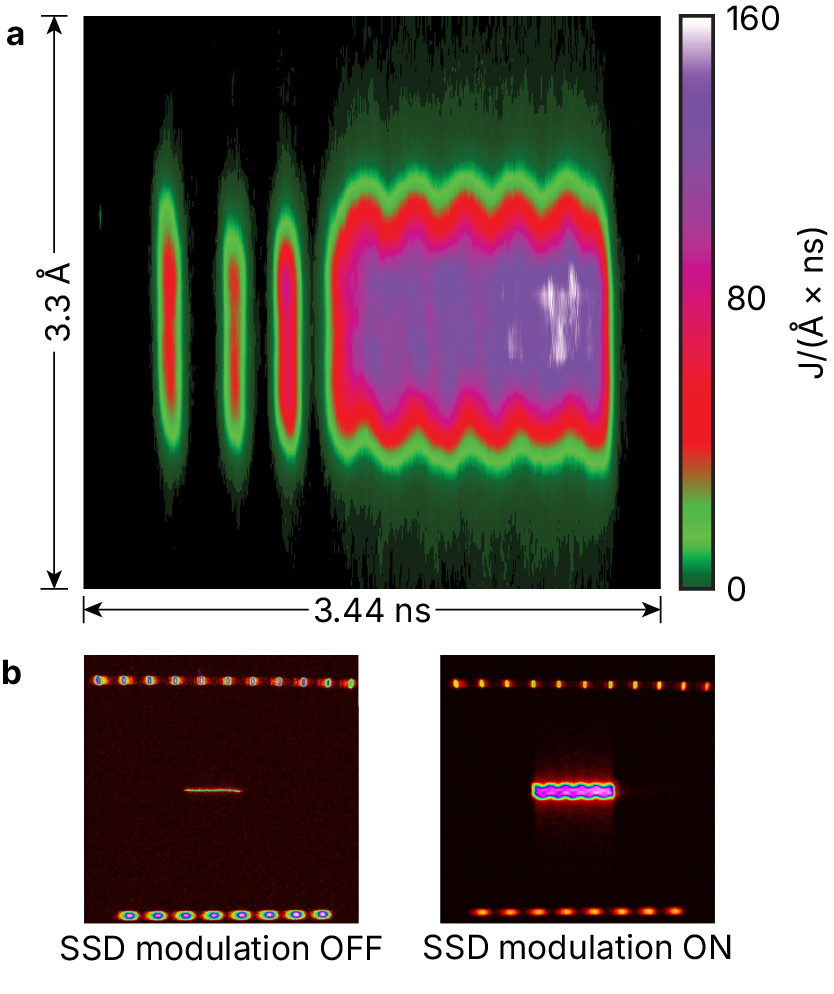
This system carefully times the picket pulse relative to the radio-frequency (rf) signal that controls the SSD wavelength modulation as measured with a streaked spectrometer. There is a specific moment in the rf cycle, called the zero crossing, when there is no wavelength shift. With no wavelength shift, there is no angular shift in the beam, so it points in the same direction as the time-averaged beam.
Using a streaked spectrometer, engineers measure how the laser spectrum changes in time (Fig. 1) and adjust the phase of the rf signal so that the peak of the picket pulse occurs exactly at this zero-crossing point. This time-averaged beam pointing ensures that the pointing during the picket matches the pointing during the rest of the pulse.
Improving Consistency from Shot to Shot
SSD also introduces a small amount of unavoidable amplitude modulation as the beam moves through apertures in the laser system. By locking the rf phase, SSD Sync ensures that this modulation is the same from shot to shot. This consistency removes a variable from the experiment, making it easier for scientists to analyze implosion performance and compare results across experiments.
Why This Matters
The OMEGA laser was designed to deliver extremely uniform irradiation to fusion targets, and beam smoothing is critical to achieving that goal. Phase smoothing (DPPs), polarization smoothing (DPRs), and SSD work together to reduce laser nonuniformity and improve implosion symmetry.
SSD Sync is a refinement of this system that becomes especially important for modern pulse shapes that include very short picket pulses. By ensuring accurate beam pointing and consistent laser performance, SSD Sync helps improve experimental repeatability and the overall quality of the scientific data collected on OMEGA.
In ICF research, success depends on precision, symmetry, and repeatability. Technologies like SSD and SSD Sync operate behind the scenes, but they play a critical role in the success of ICF experiments on OMEGA.