


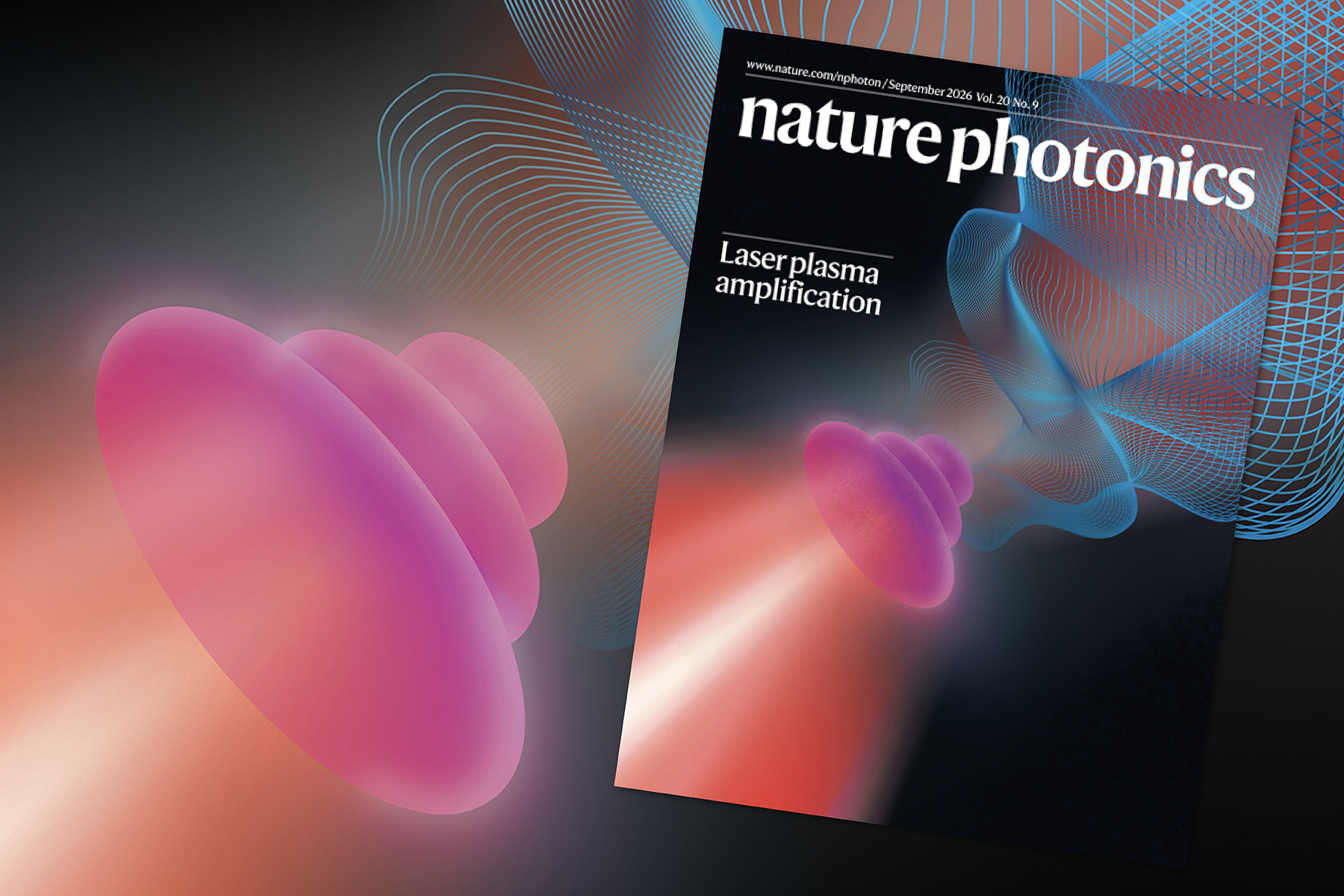
Congratulations to LLE staff scientist Jessica Shaw and her team, whose groundbreaking research has set a new benchmark in laser-plasma amplification (LPA) by achieving record energy transfer, efficiency, and temporal compression of a seed laser in plasma via Raman amplification.
Shaw’s paper, “Laser-Plasma Amplification of an Ultra-Broadband Laser Pulse to 0.3 TW,” has been published in the September 2026 issue of Nature Photonics and earned a spot on the cover. This research marks a major milestone in the field of high-intensity laser physics. Shaw’s coauthors on this paper included Manfred Virgil Ambat, Kyle McMillen, Jeremy Pigeon, Sara Bucht, Maria Almanza, Seung-Whan Bahk, Ildar Begishev, Robert Boni, Christophe Dorrer, Daniel Haberberger, Joe Katz, Isabelle LaBelle, Chad Mileham, Richard Roides, Marco Romo-Gonzalez, Isabelle Settle, Michael Spilatro, David Turnbull, John Palastro, Eduardo Paulo Alves, Hans Rinderknecht, Adam Sefkow, and Dustin Froula.
A Leap Forward: Amplifying and Compressing Laser Power
Shaw and her team achieved a tenfold improvement over previous results by amplifying and compressing an ultra-broadband—a laser pulse that emits a very wide and colorful spectrum, greater than 60 nm—and, intense (up to 3.7 × 10¹⁵ W/cm²) laser pulse to 0.3 TW—that is, 300 billion watts of power! Using Raman amplification in plasma, they demonstrated the ability to transfer energy from a longer, more-energetic pump laser to a shorter seed laser, amplifying the seed while depleting the pump. This innovative approach bypasses the material damage thresholds of solid media, unlocking new possibilities for high-intensity laser applications.
Record-Breaking Results
The team’s experiments shattered several previous LPA records, including:
- Shortest pulse duration: Amplified pulse durations were reduced by a factor of 2, achieving final durations of just 64 fs—the shortest ever measured for LPA.
- Unprecedented efficiency: Raman amplification efficiencies reached 8.7%, setting a new standard in the field.
- Energy amplification: Energy transfers exceeding 220 mJ resulted in a remarkable 30× amplification of a 7.6-mJ seed laser.
These achievements pave the way for a compact plasma “afterburner” that could revolutionize existing petawatt-class laser facilities, enabling experiments at the cutting edge of laser intensity.
Why This Matters: Unlocking the Laser-Intensity Frontier
Producing on-target laser intensities much greater than 1023 W/cm2 with current laser technologies is a challenge that scientists face when studying new areas of physics, such as strong-field quantum electrodynamics. Plasma-based laser amplification has the potential to augment traditional laser systems as an energy booster that could extend existing high-power laser systems to ten times the power without building additional large-scale laser architecture.
The Future of High-Intensity Laser Science
Shaw’s research is more than a technical achievement—it’s a paradigm shift. By leveraging plasma-based amplification, scientists can push the boundaries of laser intensity, opening doors to new discoveries in physics and beyond. This breakthrough positions LPA as a key technology for the next generation of high-power laser systems. “These results present a step forward in the understanding of what is achievable by Raman amplifiers, but there are still many more questions to answer,” says Shaw.
Read the paper in the September 2026 issue of Nature Photonics.