


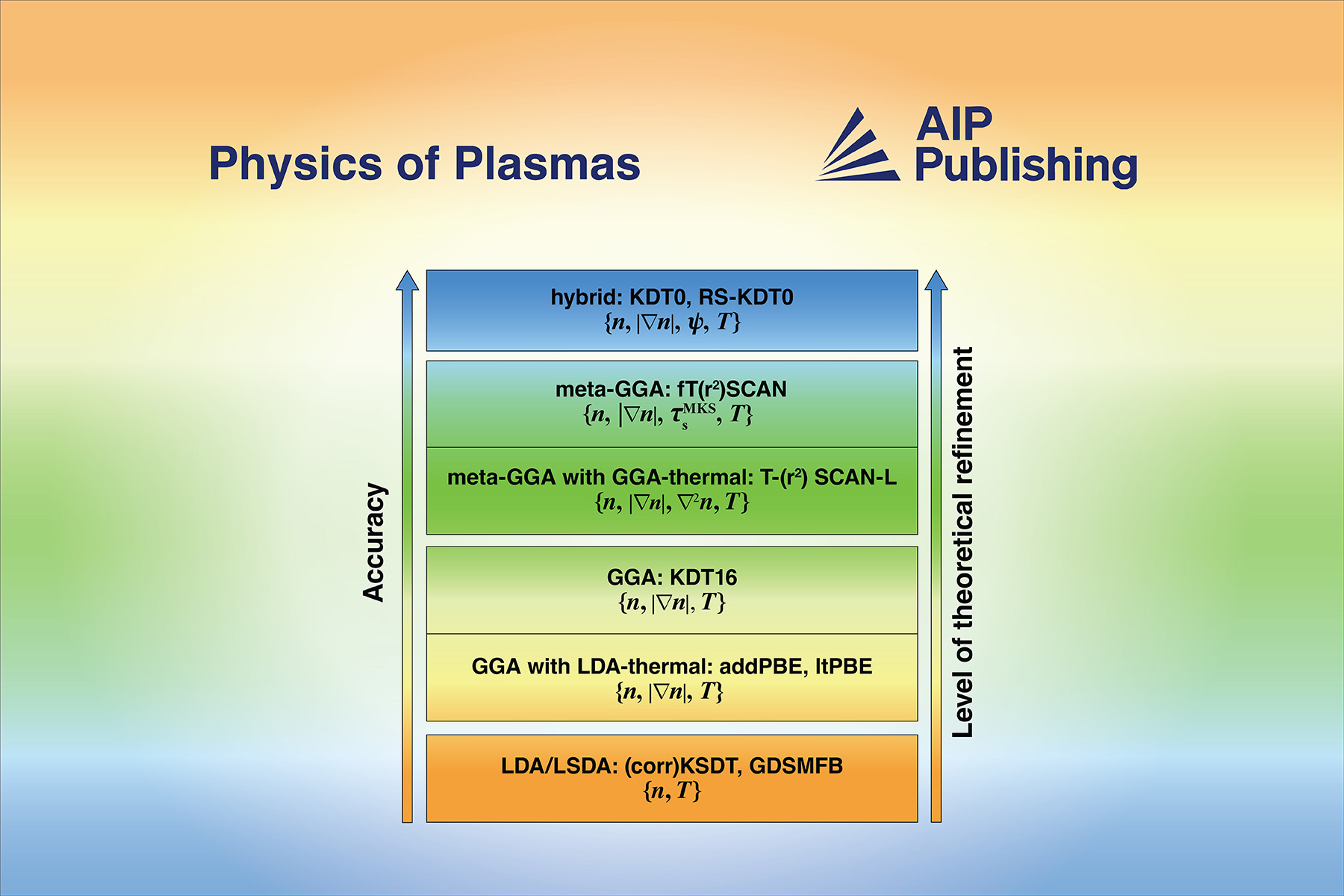
Congratulations to LLE staff scientist Valentin Karasiev and coauthors Suxing Hu, Katerina Hilleke, Ammar Ellaboudy, Deyan Mihaylov, and Samuel Trickey, whose paper “Thermal Exchange-Correlation Functionals: Capturing Quantum Electron Behavior in Warm, Dense Plasmas” has recently been selected as an Editor’s Pick in the March 2026 issue of Physics of Plasmas.
This invited paper, which was published in a special issue on the dynamics of quantum plasmas, summarizes and provides perspective upon recent progress in developing non-empirical constraint-based thermal (i.e., free-energy) exchange-correlation (XC) density functionals. Two basic thermalization principles for upgrading ground-state XC functionals to successful thermal ones are emphasized. The paper provides evidence that should be convincing to the high-energy density physics community of the necessity of use of proper thermal XC functionals in simulation studies of finite-temperature quantum effects in warm, dense plasmas.
Our grateful thanks to Valentin, who kindly took the time to answer a few of our questions, below.
What was the main objective of your experiment/project?
Ab initio molecular dynamics (AIMD) simulations using free-energy density functional theory (DFT) have become a key methodology for predicting and understanding the behavior of warm dense matter (WDM) and high-energy-density (HED) plasmas.
Free-energy DFT requires approximations for the exchange-correlation (XC) free-energy density functional, which takes into account all the quantum many-electron interaction effects. Some years ago, we and collaborators demonstrated that accurate predictions of system properties in WDM conditions require the XC approximations to have explicit temperature dependence. It is not sufficient to use the widely popular and effective ground-state (zero-temperature) approximations.
In this work, we summarize and give perspective upon recent progress in developing nonempirical constraint-based thermal (i.e., free-energy) XC density functionals. As with the zero-temperature case, there is a hierarchy of refinement and complexity. We emphasize two basic thermalization principles for upgrading ground-state XC functionals to successful thermal ones.
Refinement does not guarantee improvement, so we turn to assessment of the accuracy of well-founded functionals. We did AIMD simulations for H/D and He plasmas under selected thermodynamic conditions for which highly accurate path integral Monte Carlo (PIMC) reference data are available. Our simulations tested thermal XC functionals at five distinct theoretical refinement/complexity levels.
What did your results reveal?
A clever idea that has recurred in the specialty is to thermalize a ground-state functional at one refinement level with thermal contributions from the next lower level. But, comparisons with the PIMC data show that functionals thermalized by such augmentation are inferior to full implementation.
Specifically, a ground-state generalized gradient approximation (GGA) functional with the local density approximation (LDA) thermal contribution is inferior to both thermal LDA and fully thermal GGA functionals. This finding reveals the crucial role of the finite-T second-order gradient expansion. Schemes based on the LDA thermal augmentation do not match the second-order finite-T gradient expansion in the weakly varying density limit. This seems to be the main disadvantage of such simplified schemes versus the fully thermal Karasiev-Dufty-Trickey (KDT16) GGA, because the weakly varying density limit is important especially in the WDM regime.
Why is this work important?
Our group routinely works on establishing equation-of-state (EOS) and opacity tables (databases) for materials relevant to inertial confinement fusion, such as H/D, CH, CHON, SiO2, across a wide range of thermodynamic conditions. Such tables are required input to the hydrocodes used to simulate implosions on LLE’s OMEGA and OMEGA EP lasers. There is a dramatic dependence of the reliability of our predictions based on those AIMD simulations upon the accuracy of the XC functional utilized. Thus, development, testing, and validation of explicitly T-dependent XC density functionals across large temperature ranges is a critically important task. Our paper provides broad, convincing evidence to the high-energy-density physics community of the critical role of proper thermal XC functionals in simulation studies of finite-temperature quantum effects in warm, dense plasmas.
What are your next steps?
Currently there are two functional classes: (i) semilocal ones that give accurate AIMD trajectories and related EOS data, but systematically underestimate band gaps and related direct current (DC) conductivity and other transport properties; and (ii) “hybrids” that include a fraction of thermal Fock exchange that therefore give much more reliable band gap values and related properties but computationally are much more expensive. Our next step is to develop a thermal semilocal XC that effectively predicts energetics and effectively takes into account nonlocality providing reliable predictions for band gaps and related properties just as nonlocal hybrid functionals. That would be a major step forward in development of reliable and efficient first-principles simulations methods.