


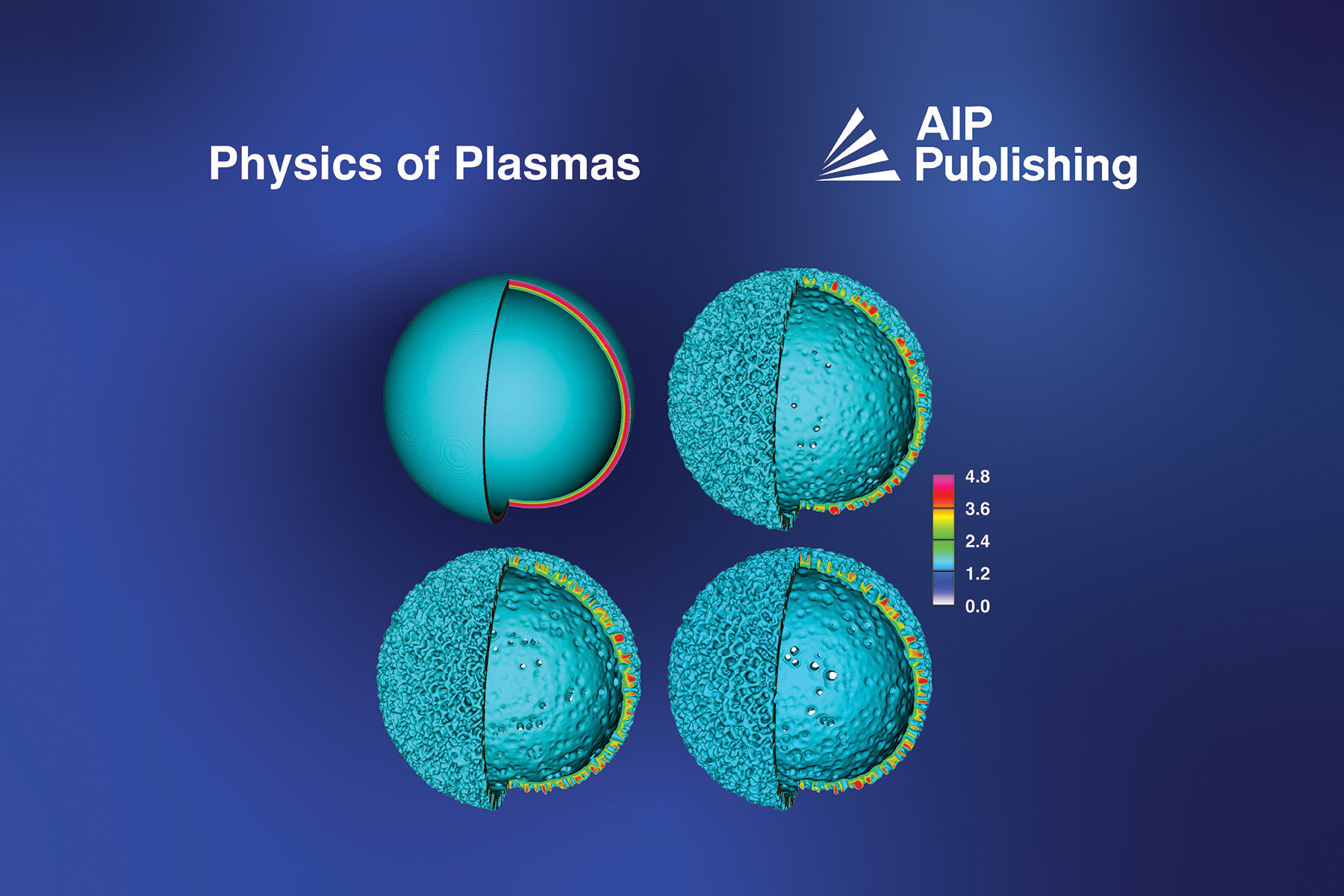
Congratulations to LLE senior scientist Igor Igumenshchev and coauthors Alexander Shvydky, Valeri Goncharov, Andrey Solodov, Adrien Pineau, Riccardo Betti, and Jim Knauer, whose paper “Wetted-Foam Target Stability for Laser-Direct-Drive Inertial Confinement Fusion” was recently selected as an Editor’s Pick in the June 2026 issue of Physics of Plasmas.
The research presented in this paper investigates the effects of wetted-foam ablators in direct-drive inertial confinement fusion cryogenic implosions on the OMEGA laser using highly resolved 3D radiation-hydrodynamic computer simulations and compares the performance of these implosions with that of implosions using targets with solid-plastic ablators.
Our thanks to Igor for taking a few moments to answer our questions:
What was the main objective of your experiment/project?
Our research involved using computer simulations to investigate the effects of wetted-foam ablators in OMEGA laser-direct-drive cryogenic-target implosions. Wetted foams—a plastic foam matrix filled with liquid or ice deuterium–tritium (DT)—are a type of “hybrid” material proposed as an ablator material that potentially combines the best properties of ice DT and solid CH materials.
What did your results reveal?
We found that our results did not reveal the expected enhancement of the stability of implosion targets when using wetted-foam ablators. Moreover, our simulations revealed that foam inhomogeneities introduce perturbations, which can significantly reduce the implosion performance. To reduce the deleterious effects of these ablators, one needs either to reduce the size of foam random-structure inhomogeneities (i.e., reducing the foam pore sizes to less than ~0.2 microns) or use a regular layered-structure foam matrix.
Why is this work important?
This work is important because it is the first study on the effects of heterogeneous wetted-foam ablators in cryogenic implosions using large-scale computer simulations. The results will be useful in designing ignition-scale targets with improved implosion performance.
What are your next steps?
Our next steps will be to expand this study to ignition-scale implosions and investigate in further detail the promising designs of foam matrixes of regular layered structures.