


Vicente Valenzuela-Villaseca, Lawrence Fellow at Lawrence Livermore National Laboratory, and his team have recently published a new paper in Astrophysical Journal that builds on over ten years of collisionless shock experiments at LLE. “Laboratory Measurements of Energy Partitioning and Anomalous Electron Heating in Magnetized, Perpendicular Collisionless Shocks” reports on an experiment conducted on LLE’s OMEGA Laser System that resulted in the first laboratory observation of a fully developed, magnetized collisionless shock under conditions relevant to the shocks that form where the solar wind encounters the Earth’s magnetic field. Because of this work, the American Astronomical Society (AAS) has listed the OMEGA Laser System as a facility for astrophysics research—a particularly notable designation since most AAS facilities are telescope observatories or computational resources.
Our thanks to Vicente Valenzuela-Villaseca and LLE scientist and coauthor Peter Heuer for sharing more about this important research.
What are collisionless shocks?
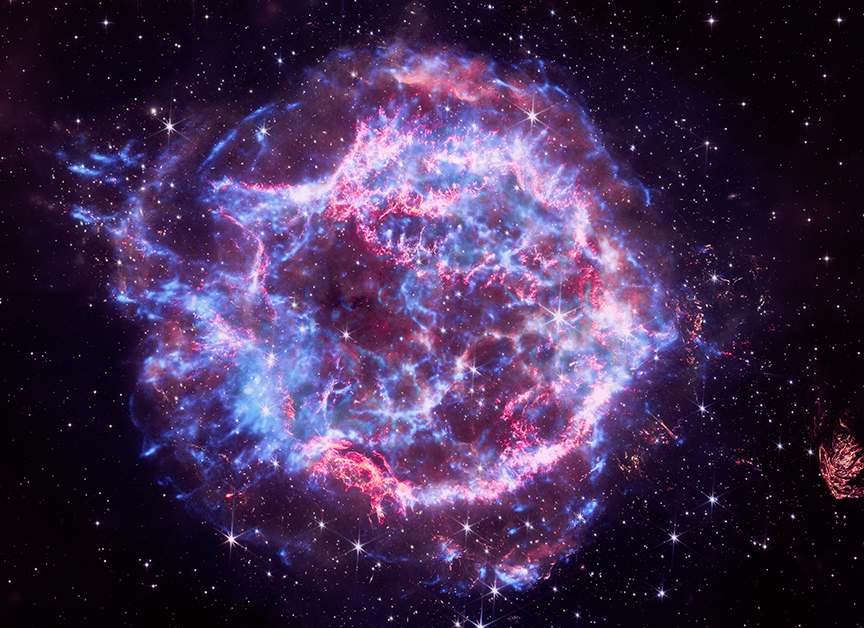
Collisionless shocks are shockwaves mediated by nonlinear and complex electromagnetic fields rather than binary collisions between particles. These types of shocks are common in space and astrophysics including planetary bow shocks, supernovae explosions, and high-altitude nuclear explosions. However, the mechanisms of energy flow and particle heating across these shocks are poorly understood. For example, spacecraft measurements suggest that these shocks heat electrons significantly more relative to the ions than predicted by theory and simulations.
Could you expand upon some of the challenges you faced in conducting this experiment?
Space is a great laboratory for studying plasma physics but it has some limitations: namely, we do not control the “experiments” and the objects of interest are sometimes light-years away. Since it was proposed in ~2000, scientists have been trying to generate similar shocks in laboratory environments using high-power lasers and strong magnetic field coils so we could systematically vary the shock parameters and observe them up close. The primary challenge was driving shocks in the laboratory with parameters comparable to astrophysical shocks. Two particular challenges are reaching relevant Mach numbers (fast-enough flows) and allowing the shock to develop long enough that it separates from the “piston” (the laser-produced plasma that drives the shock) so that a distinct downstream region exists, since many of the properties of interest are in the downstream. Experiments of this type have been conducted on a variety of laser facilities, and have been developed at LLE over the past decade.
What did the results reveal?
The density and temperature profiles collected in the experiment show that a shock was formed in a regime relevant to some astrophysical systems. Equally importantly, it showed that the shock has separated from the “piston,” which had not previously been the case. This means that this experiment is finally situated to make the kinds of measurements astrophysicists and space scientists are interested in.
Why is this research important?
Collisionless shocks are ubiquitous in the universe, but we don’t fully understand the plasma processes that form them, so we can’t explain or predict all of their properties. The Earth’s bow shock protects Earth from the solar wind, and modeling the bow shock is important for predicting the effects of space weather on Earth. On larger scales, shocks driven by supernovae are believed to be very efficient particle accelerators that may be responsible for generating many of the cosmic rays we observe on Earth, but the details of the acceleration mechanisms are not certain. This experiment brings us a step closer to being able to answer some of these questions with future laboratory experiments.
The main objective of this experiment was to generate a shock that lives long enough to measure how energy is split between electrons and ions after they have passed through a shock. This energy split is a key metric by which astronomers study astrophysical shocks, in part because it directly impacts how well shocks can accelerate particles. But despite decades of study, theoretical predictions still contradict spacecraft measurements. This experiment provided a laboratory measurement of this ratio, which was found to be consistent with spacecraft measurements (and therefore, also disagreeing with theoretical predictions).
What are your next steps?
These results provide a new experimental benchmark for understanding how shock waves in space distribute energy and therefore open the door to a variety of future experimental campaigns—several of which our teams are working on developing now. One such effort is to measure how the aforementioned energy split changes with different speeds of the shock since this is the most direct comparison to what astronomers measure.