
Timeline
1979
1977
1974
1972
1970
2011
1978
1976
1975
1973
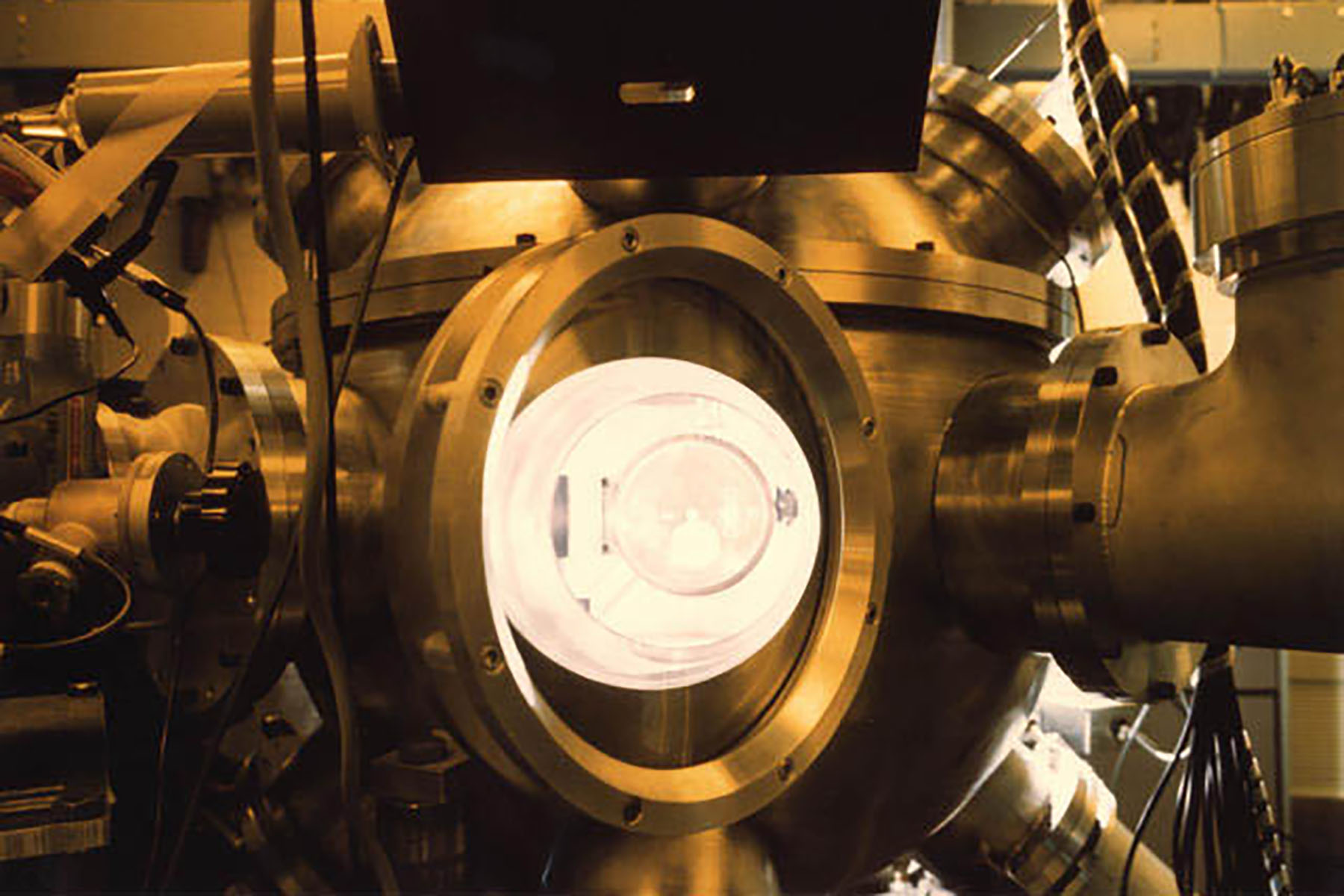
DELTA Target Chamber Between 1971 and 1975, the first four-beam LLE system, DELTA, was built and operated. DELTA was an ~1-kJ Nd:glass laser used to investigate the interaction of high-power laser radiation and plasma with particular emphasis on laser fusion. The vacuum chamber pictured below was used for a variety of early laser–matter interaction and implosion experiments at LLE in the early to mid-70s. Some of the pioneering experiments conducted on DELTA included: cryogenic deuterium targets, early measurements of stimulated scattering in laser-produced plasmas, and compressed plasma density measurements using Stark broadening of x-ray lines.
Numerical Modeling of Laser-Produced Plasmas In an article titled “Numerical Modeling of Laser Produced Plasmas,” Edward Goldman, who headed the LLE theory effort at that time, published results on numerical modeling in Plasma Physics. Theoretical calculations showed the benefits of short-wavelength laser irradiation for laser-fusion targets. There was also an interest in the use of laser fusion for the production of fissile materials by one of LLE’s major sponsors, General Electric. A paper based on DELTA experiments by Goldman, Soures, and Lubin on the “Saturation of Stimulated Backscattered Radiation in Laser Plasmas” was published in Physical Review Letters (PRL) in 1973. E. B. Goldman "Numerical Modeling of Laser Produced Plasmas: The Dynamics and Neutron Production in Dense Spherically Symmetric Plasmas," Plasma Physics. 15, 289–310 (1973). L. M. Goldman, J. Soures, and M. J. Lubin "Saturation of Stimulated Backscattered Radiation in Laser Plasmas," Phys. Rev. Lett. 31 (19), 1184–1187 (1973).
1971