



On Friday, July 17, a ribbon-cutting ceremony celebrated the new MTW-OPAL target chamber. LLE has traditionally focused on science created by “long-pulse” lasers, but the development of chirped-pulse amplification and its implementation on MTW-OPAL, an ultrashort-pulse laser, has opened the opportunity to expand the lab’s scientific portfolio. Developing new short-pulse science opportunities supports LLE’s broader mission of building NSF OPAL, a next-generation short-pulse, high-power laser, and the MTW-OPAL facility, the prototype front-end for NSF OPAL, will serve as a vital training ground for this future facility, which is currently under development.
MTW-OPAL will bridge the gap between small-scale, single-user lasers and large-scale, national user laser facilities (e.g., OMEGA, OMEGA EP, and eventually NSF OPAL) and create an R&D ecosystem capable of developing innovative ideas from proof-of-principle demonstrations to implementation at scale. Most importantly, it will offer a unique and cost-effective opportunity to educate scientists and engineers.
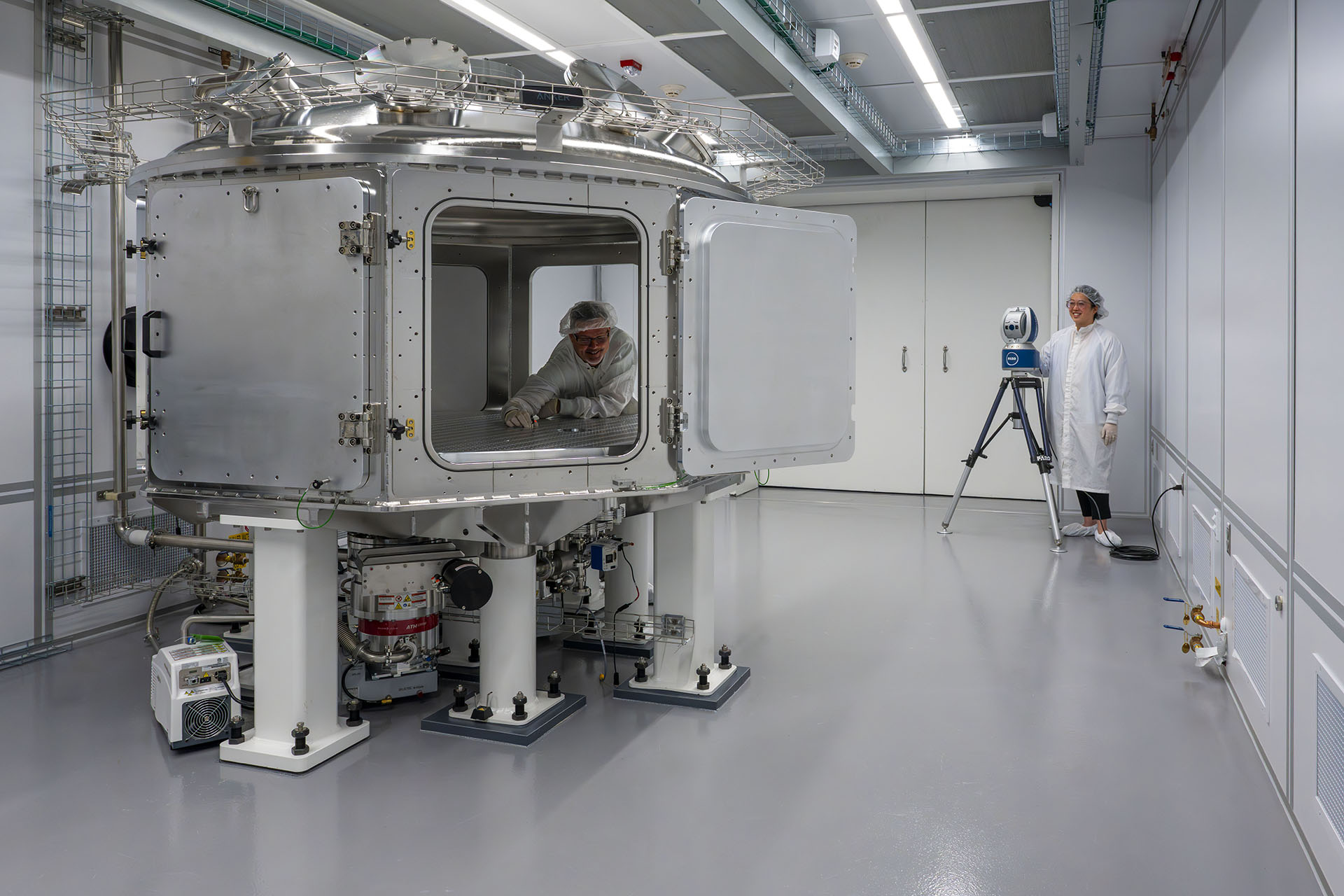
Aligning the MTW Target Chamber at the Laboratory for Laser Energetics
MTW-OPAL will offer researchers across a wide variety of disciplines including high-power lasers, ultrashort-pulse laser–matter physics, optics, THz science, high-energy-density physics, and beyond with the opportunity to advance novel science while also providing hands-on training and science education for graduate students, engineers, and technicians.
The Target Chamber is designed to enable light–matter interaction studies over a large experimental parameter space and will enable experiments on back-filled, low-density atomic and molecular gases, supersonic gas jets, and solids, offering a large range of target densities (1016 to 1023/cm3), propagation distances (1 mm to 10 m), focusing geometries, and laser intensities. As such, this chamber will provide a highly flexible foundation for both current and future experiments.
Solid-target interactions, which can produce significant ionizing radiation, were previously not feasible due to the lack of appropriate shielding, but the MTW-OPAL target area is a shielded bunker constructed with 2-ft.-thick concrete walls, ceiling, and floor that will ensure the safe containment of ionizing radiation. This new facility will enable researchers to:
- Safely perform solid-target experiments using the existing MTW-OPAL beam
- Use MTW-OPAL as a developmental platform for NSF OPAL experiments
- Develop new diagnostic platforms for OMEGA and NSF OPAL
- Train a new generation of operators and technicians
Congratulations to everyone who helped make this incredible achievement possible.