


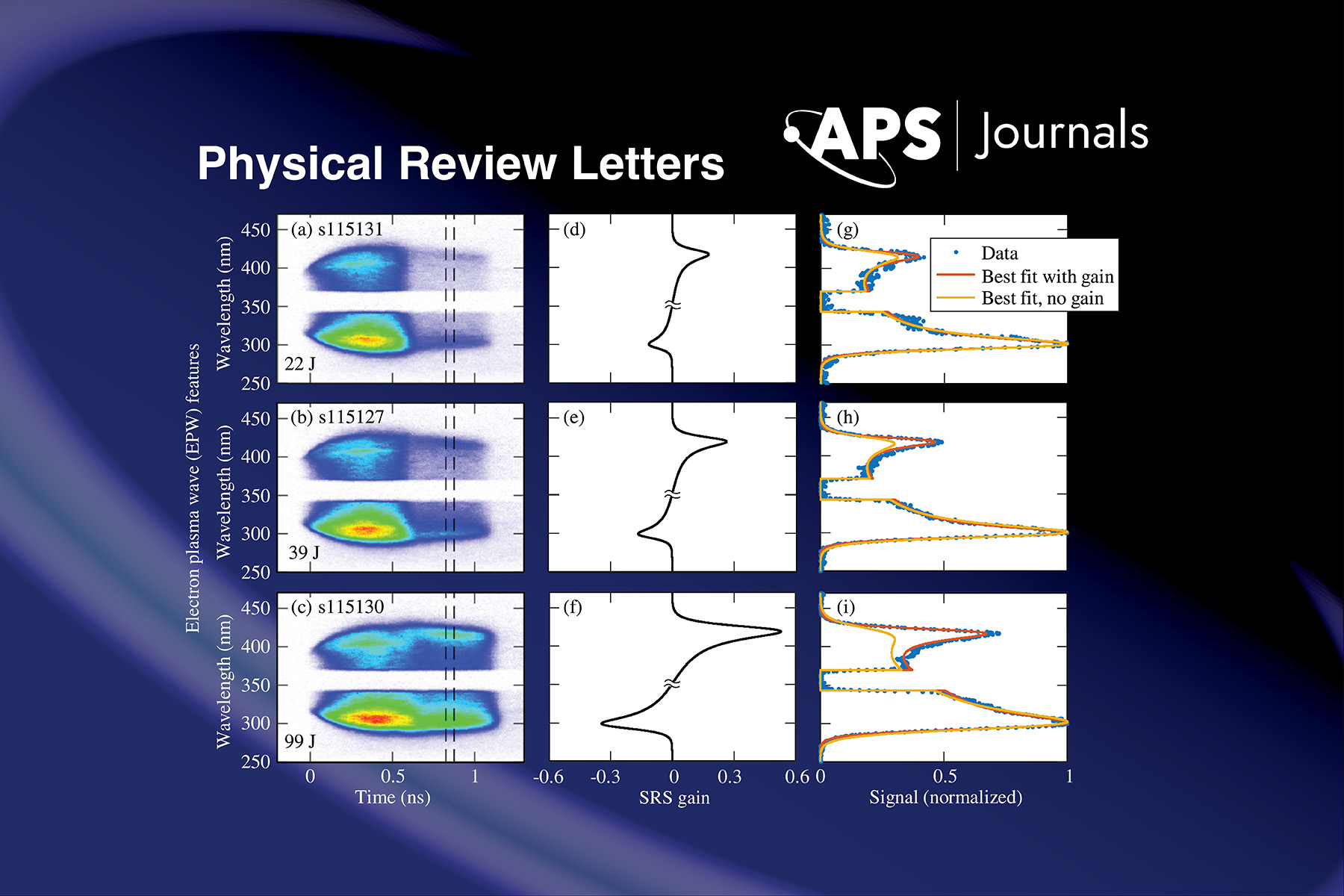
Congratulations to LLE scientists David Turnbull and coauthors Avi Milder, Russ Follett, Joe Katz, and Dustin Froula, whose paper “Thomson Scattering with Gain” has recently been published in Physical Review Letters. Turnbull and his coauthors conducted their experiment on the gas-jet platform on the Omega Laser Facility here at LLE and show that the use of a finite-intensity Thomson-scattering probe beam necessarily implies that there are finite convective gains for instabilities that arise within the system, which are discussed below. Our thanks to David for taking the time to share more about this work.
What is Thomson scattering?
Thomson scattering—in which a probe laser scatters off of thermal fluctuations in a plasma to diagnose properties like its density, temperature, and flow velocity—is a widespread technique that is typically assumed to be non-perturbative. However, the probe laser is often intense in order to obtain an adequate signal-to-noise ratio despite the small Thomson-scattering cross-section. When an intense laser propagates through plasma, it can excite instabilities such as stimulated Raman scattering (SRS) and stimulated Brillouin scattering (SBS), in which the incident laser beats with the scattered light to drive up super-thermal plasma waves that enhance the scattering losses to energetically significant levels. Typically, Thomson scattering and instabilities are treated separately.
What does this work demonstrate?
Here, we show that stimulated amplification modifies Thomson-scattering data under typical conditions, even when the instability growth is small enough that scattering losses remain energetically insignificant. Interpreting Thomson-scattering signals without accounting for the instability growth (as all prior analysis has done) can result in significant errors in the inferred plasma conditions—here, up to 20%. This effect likely explains anomalous inferences of “heat flux” in previous data (used to explain ion-acoustic wave peak asymmetries), as well as the longstanding challenge to fit red- and blue-shifted electron-plasma wave features with a single set of input parameters. We provide a unified treatment that should improve the analysis of Thomson-scattering data moving forward.
Why is this work important?
This work is important because Thomson scattering is a very common technique used to measure plasma conditions. In turn, having accurate plasma conditions to input into models is crucial for validating a wide variety of plasma physics phenomena. We showed that the traditional model used to date to extract plasma parameters from Thomson-scattering data is incomplete because it does not account for instability growth within the scattering volume. We modified the standard Thomson-scattering model to account for instability growth and show much improved agreement with data. Fitting with the traditional model has likely been a source of error in all previous Thomson-scattering measurements; here, the errors in the inferred plasma conditions approached 20% when using the previous fitting technique.
What are your next steps?
The next step is that we hope this revised model is adopted by the broader community to improve the accuracy of plasma characterization in a wide variety of plasma physics experiments.