


A future NSF OPAL laser user facility will require extremely large all-reflective optics estimated to weigh up to 1000 pounds using traditional solid substrates. Large beams are required to prevent laser-induced damage while delivering 25-PW peak-power pulses. Such massive substrates prove impractically expensive, however, given the need for up to 75 flat mirrors and up to 20 large off-axis parabolic mirrors, plus associated optomechanics required to achieve few-micron focusing and pointing stability.
Conventional methods to produce lightweight mirrors mechanically remove up to 90% of a solid substrate and then bond a faceplate to this “core” that can be finished to provide the required reflective surface. This approach adds cost, increases production time, and generates a significant amount of waste material. Therefore, developing methods to produce low-cost, lightweight mirrors would significantly reduce overall NSF OPAL facility costs.
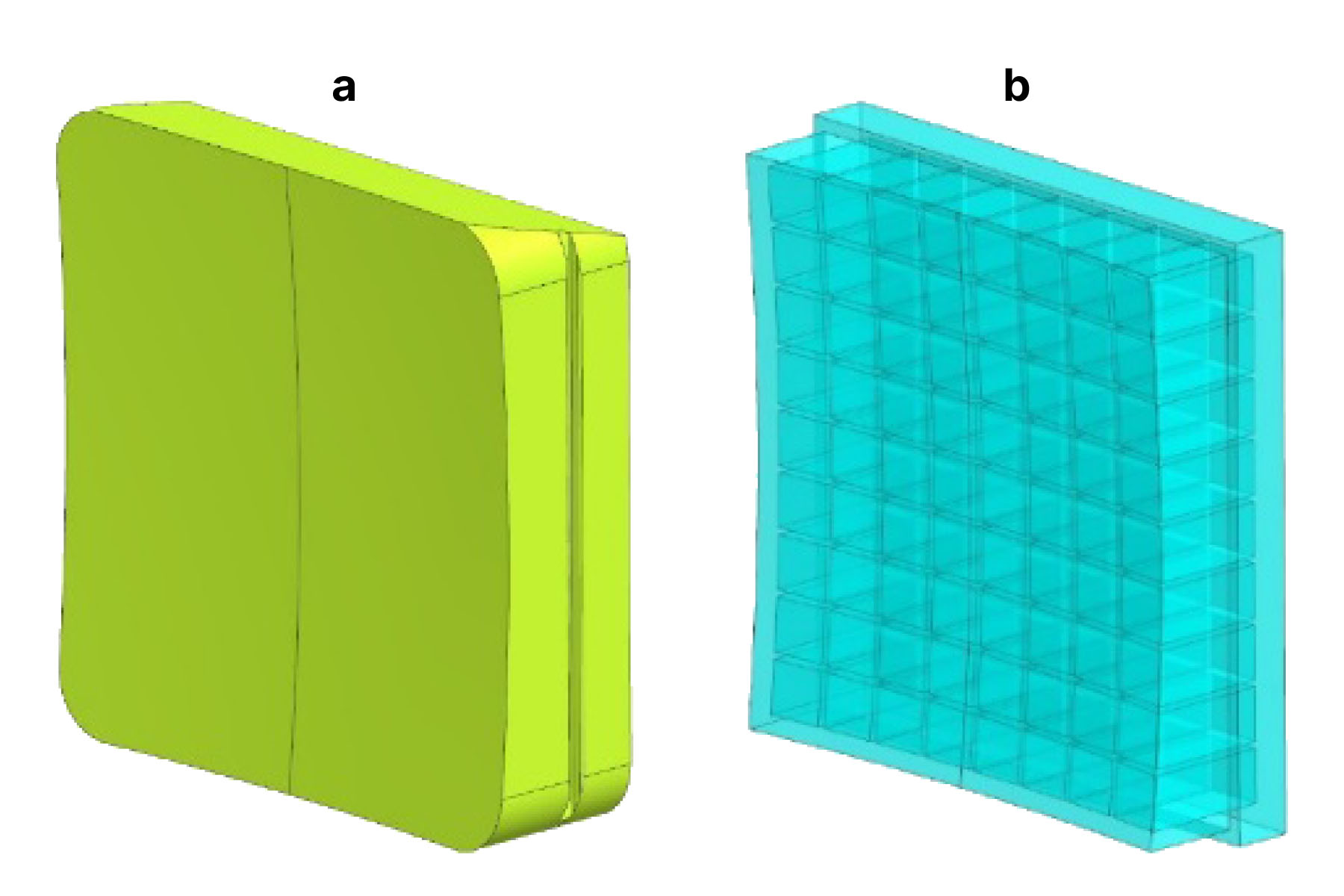
Figures 1(a) and 1(b) illustrate examples of OMEGA EP off-axis parabolic mirrors using solid and lightweight substrates, respectively. The solid substrate shown in Fig. 1(a) has a reflective surface and other features, like side grooves for mirror mounts. These features are machined from optical materials like fused silica, which prove very expensive at the required size.
Figure 1(b) exemplifies new concepts that have emerged for constructing lightweight mirror cores. The supporting frame is constructed as a grid, with rectangular or hexagonal cells. The ribs are fabricated to define the reflecting surface. For focusing reflectors, the rough shape of the front reflector can be formed by “slumping” a flat glass faceplate onto the constructed core, which results in a shape within a few tens of microns of the prescribed surface that can be figured using conventional methods.
The lightweight structure can be formed using laser welding, glass-frit bonding (glass soldering), or low-outgassing optical adhesives to construct the core and attach the faceplate to the core. Additive manufacturing (3D printing) provides an alternate method to fabricate metal or glass-constructed cores. The faceplate can be polished and coated using the same processes used to provide highly reflective surfaces for solid mirrors. The faceplate thickness determines how much of the core pattern “prints through” to the front surface. Testing demonstrates that glass faceplates with thicknesses in the range of 6 to 10 mm do not exhibit print-through, which is referred to as “quilting.”
Lightweight mirror substrates must survive production steps, such as the polishing and deposition of reflective optical coatings that can involve temperatures up to 150°C and vacuum cycles. Vents are required in the lightweight mirrors to prevent air from being trapped when operated in vacuum. Fortunately, strong interest exists in industry to produce lightweight mirrors needed for astronomical telescopes, especially for space-based and airborne applications where minimizing weight proves essential and reducing cost is highly desirable [1,2]. This broad commercial demand and capacity will be essential for realizing the required optical performance and reducing costs.
The NSF OPAL design team has presented its needs to numerous companies and initiated a three-phase program that will start by testing promising methods by prototyping subscale mirrors. A request for proposals yielded cost estimates as much as five times lower than comparable solid substrates.
Corresponding author: M. Meyers