


NSF OPAL is a proposed future user facility at LLE that is intended to enable scientists to create and study matter under extreme conditions [1]. To study these conditions, NSF OPAL laser pulses must be incredibly clean. When a laser fires, sometimes a small amount of energy leaks out before the main pulse. These early flashes—called prepulses—can damage or change the target before the main shot even arrives, which can ruin the experiment. To avoid this, NSF OPAL must have an extremely high temporal contrast, which means that any prepulse needs to be vastly less powerful than the main pulse. The contrast must be greater than one part in one hundred billion (i.e., 1011). To get a sense of scale, imagine comparing one meter to the distance between Earth and Mars—an enormous difference that shows just how precisely NSF OPAL laser pulses must be controlled.
Several methods can “clean” laser pulses to achieve higher temporal pulse contrast. Plasma mirrors, described on p. 25 of this issue (“Liquid Crystal Plasma Mirrors”), can improve temporal contrast by approximately 100× per mirror by highly reflecting only the parts of the pulses that are above breakdown intensity. By design, plasma mirrors must be replaced or refreshed after every laser shot.
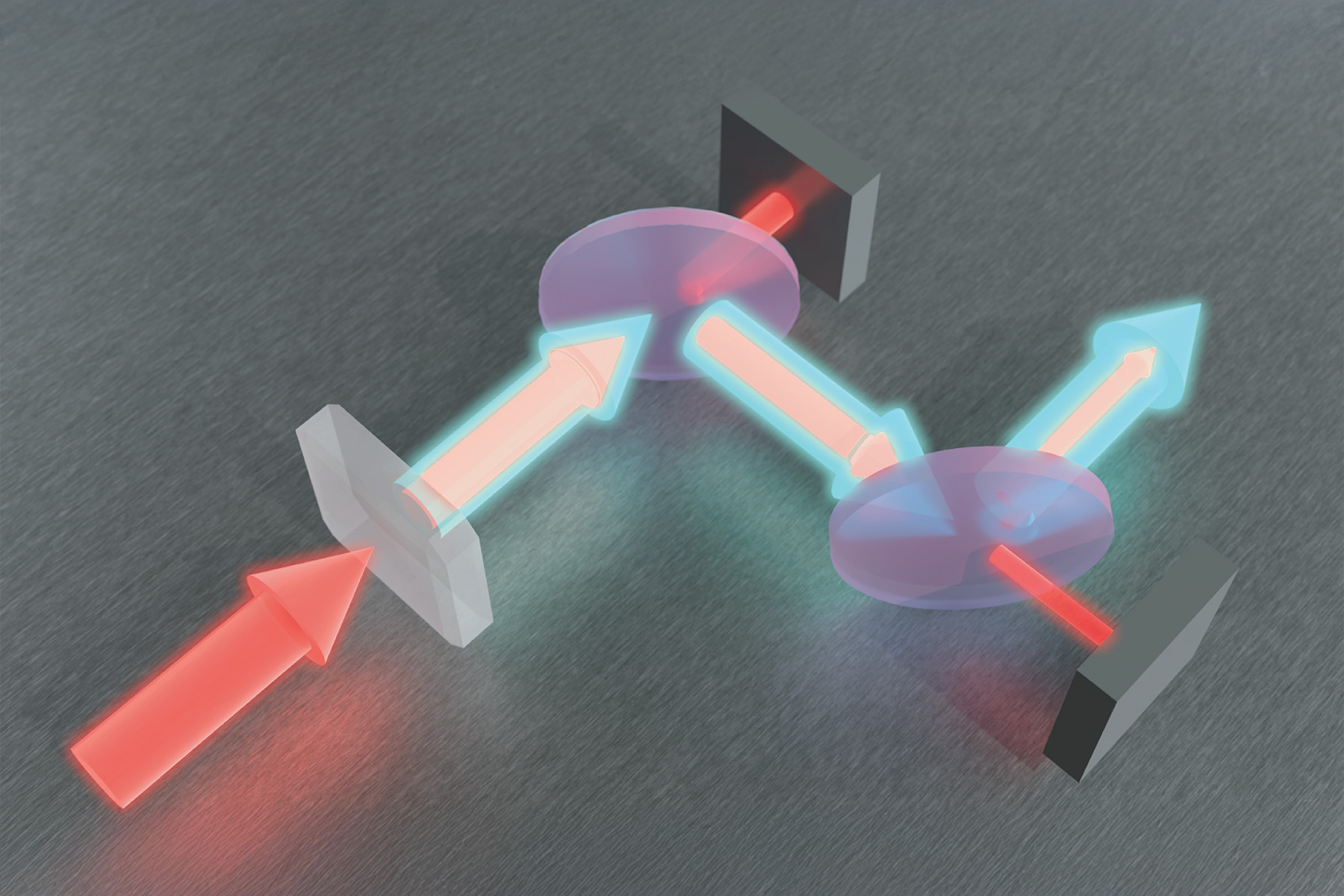
Second-harmonic generation (SHG) is a nonlinear optical process that doubles the laser frequency (1ω to 2ω, or halves the wavelength λ to λ/2). SHG provides another powerful pulse-cleaning approach since high efficiency can be achieved, and its small-signal conversion efficiency varies according to the square of the laser intensity (ISHG ∝ ILaser2). Separating the 2ω output from the unconverted (1ω) laser pulse can be accomplished using dichroic mirrors that preferentially reflect 2ω pulses, as shown in Fig. 1(a). Theoretically, the temporal contrast of NSF OPAL laser pulses with 1010 temporal contrast could be improved up to 1020.
Frequency doubling intense laser pulses requires thin nonlinear crystals. SHG pulse cleaning on the Orion laser at the Atomic Weapons Establishment has demonstrated great utility using a 3-mm-thick, free-standing, 300-mm-diam KDP crystal to produce SHG pulse energies up to 100 J at 500 fs [2]. Similar performance was achieved using an 800-µm-thick LBO crystal with a 185-mm-diam titanium-sapphire laser beam to produce 8-J, 30-fs pulses [3]. Larger-aperture crystals for these thicknesses proved impractical to fabricate, which limited the maximum SHG energy from both laser systems. NSF OPAL would require even thinner KDP crystals (~200 µm) to frequency convert 20-fs, 620-mm square beams. The L4 ATON laser at ELI Beamlines [4] faces a similar SHG challenge to frequency double its 1.5-kJ, 150-fs pulses with the same beam size as NSF OPAL.
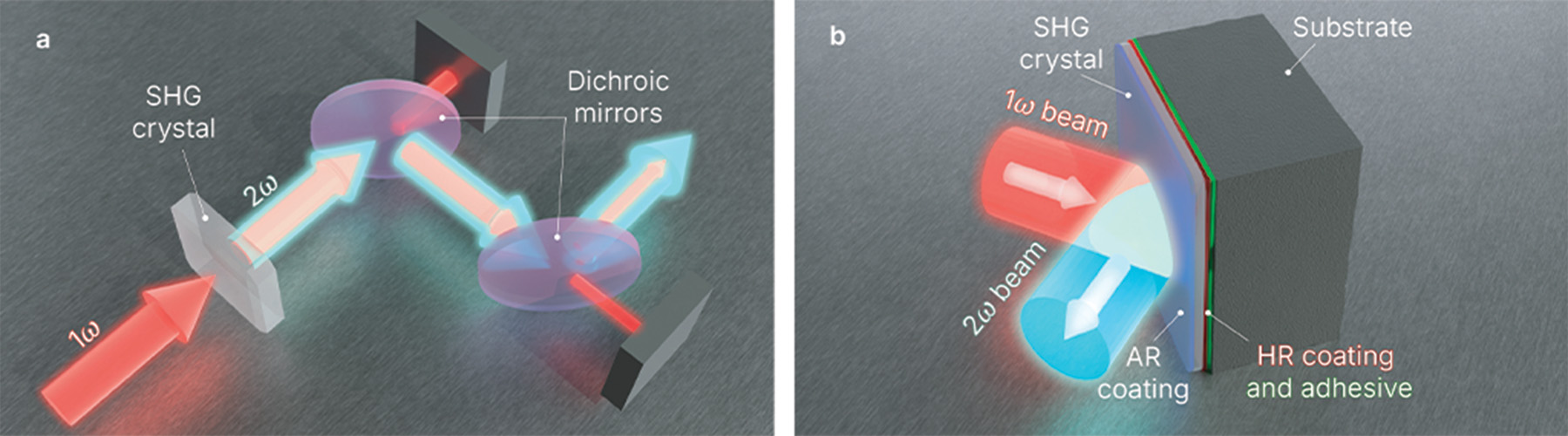
Figure 1(b) conceptually illustrates a solution suitable for high-energy lasers: SHG mirrors. An SHG crystal with suitable antireflection and high-reflection coatings is mounted on a thick substrate to provide the mechanical stability required for ultrathin crystals. SHG mirror designs can optimize SHG phase matching for either incident 1ω pulses and reflect the 2ω output, or reflected 1ω pulses. Conventional optical manufacturing processes, like single-point diamond turning, would reduce the SHG crystal thickness in the assembly before applying the front-surface antireflective coating. LLE has started collaborations to develop SHG mirror technology that will be discussed in a future issue of LLE In Focus.
Corresponding author: J. D. Zuegel