


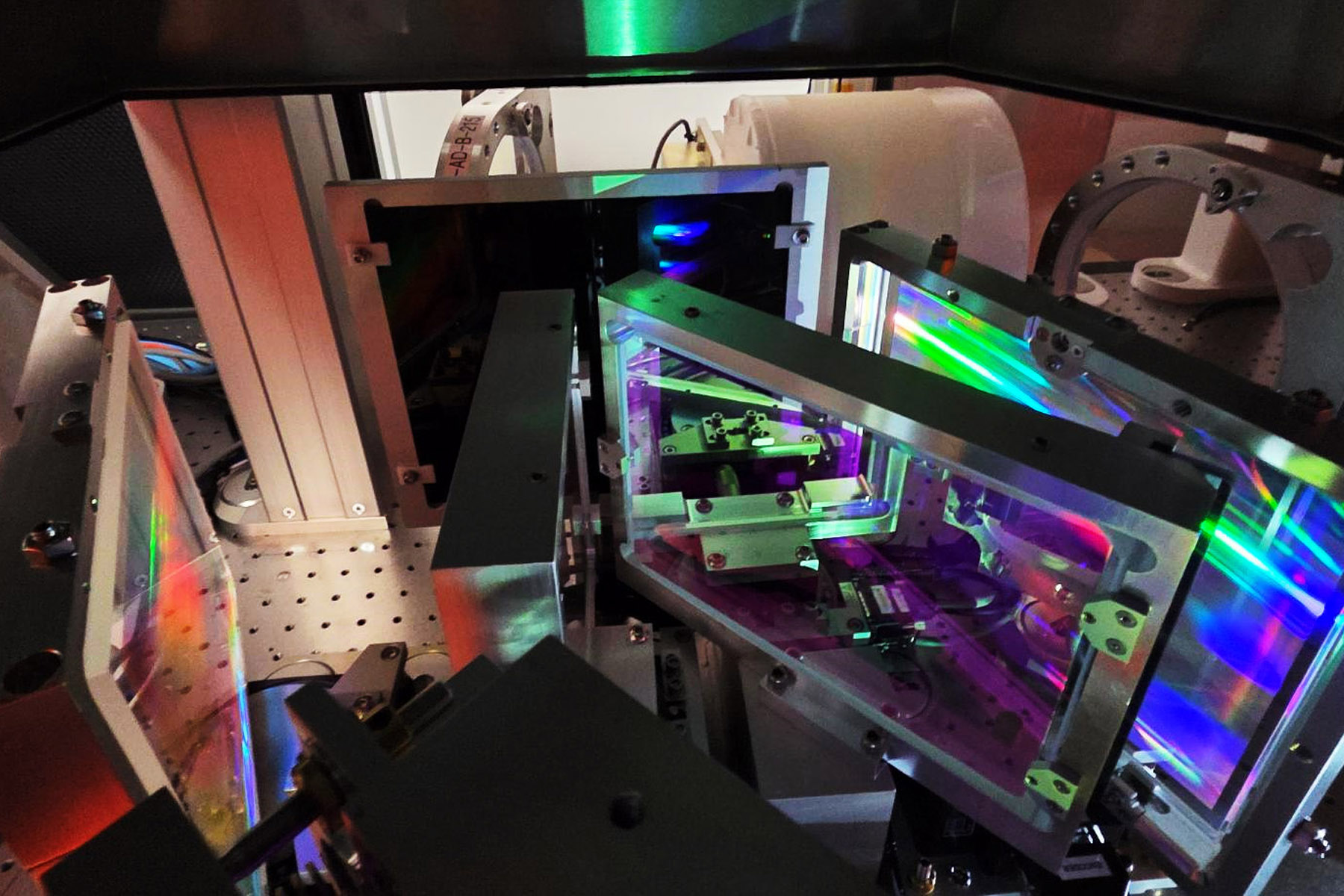
A Next-Generation Broadband Laser for Direct-Drive Fusion Experiments
A New Laser Concept to Mitigate Laser–Plasma Instabilities
Achieving fusion in the laboratory has proven a grand challenge of science. At its heart, fusion requires incredibly high pressures and temperatures—conditions rarely seen outside stellar cores. In December 2022, the National Ignition Facility (NIF) achieved a milestone in an indirect-drive inertial confinement fusion (ICF) experiment that produced more energy from ignition than the laser energy delivered to the target chamber. Direct-drive ICF promises a more efficient approach since it does not involve converting laser energy to x rays that drive NIF implosions. Obstacles that remain, however, are laser–plasma instabilities (LPIs) that can disrupt the laser energy delivered to the target.
Laser–Plasma Instabilities: A Barrier to Progress
When a high-power laser beam strikes a fusion target—a small capsule filled with deuterium and tritium fuel—the surface of the capsule ablates, forming a plasma: a hot, charged “soup” of ions and electrons. Ideally, the laser energy transferred to this plasma drives the underlying fuel inward, with the resultant implosion achieving the pressure and temperature needed for ignition. In reality, the laser interacting with the plasma creates a breeding ground for LPIs that significantly degrade direct-drive ICF implosions. Significant LPIs include:
- Stimulated Brillouin scattering (SBS): The laser wave couples with plasma sound waves, redirecting the laser energy. Multiple laser beams can interact in the plasma via SBS to exchange energy and degrade the required direct-drive spherical symmetry.
- Stimulated Raman scattering (SRS): The laser excites electron plasma waves, causing energy to scatter backward, which reduces the laser energy driving the fuel and can generate unwanted “hot” electrons that preheat the target and spoil the implosion.
- Two-plasmon decay: Another LPI mechanism that can ruin carefully designed compression experiments by generating “hot” electrons from laser-driven plasma waves.
Why Laser Bandwidth Matters
Solid-state ICF lasers historically use narrowband (nearly single color) lasers. Narrow bandwidth aggravates LPIs since the ICF laser beams on target can operate at intensities above the threshold for each LPI and resonantly drive the associated plasma waves. Powerful solid-state ICF lasers, like the NIF and OMEGA, deliver near-ultraviolet (UV) laser pulses at 351 nm, a preferred wavelength regime for fusion experiments, with “fractional bandwidths” less than 0.15% (Δλ/λ0, where Δλ is the bandwidth and λ0 is the center wavelength) [1].
Experiments and modeling suggest that using laser pulses with a broader range of wavelengths can disrupt these regular patterns and scramble the conditions needed for unwanted LPIs to thrive [2]. LPIs depend on precise “resonance” conditions between the laser frequency, plasma frequency, and various plasma waves. Broadband laser pulses can reduce or even eliminate these conditions, thereby increasing LPI thresholds and enabling a more uniform, symmetric drive essential for successful direct-drive ICF implosions.
Engineering a Solution: The FLUX System
The Fourth-generation Laser for Ultra-broadband eXperiments (FLUX) has been built at LLE to meet the challenge of mitigating or even suppressing LPIs. The FLUX system is designed from the ground up to generate, amplify, and convert broadband laser pulses to the UV with a much wider bandwidth—reaching up to 1.5%, an order of magnitude improvement over previous systems [3–5].
FLUX begins by producing a low-energy broadband pulse in the infrared in a fiber front end. A fiber-laser system shapes the spectrum and temporal shape of this broadband seed pulse, as well as two sets of narrowband seed pulses amplified by separate pump lasers. The resulting pump pulses, after laser amplification and frequency doubling from the infrared (1053 nm) to the green (526.5 nm), amplify the broadband seed via optical parametric amplification (OPA), then frequency convert the broadband infrared pulse to the ultraviolet via sum-frequency generation (SFG).
OPAs amplify the broadband seed in nonlinear optical crystals by splitting higher-energy “pump” photons into pairs of lower-energy “signal” and “idler” photons. By design, the FLUX system uses a pump wavelength of 526.5 nm, and the signal is at wavelengths shorter than 1053 nm, resulting in idler wavelengths longer than 1053 nm. OPAs can operate with the input seed and pump propagating in slightly different directions (noncollinear OPA, NOPA), or with ideally co-propagating seed and pump, which results in co-propagating signal and idler beams, as is the case for the high-energy FLUX OPA (collinear OPA, COPA). SFG combines the amplified infrared signal and idler photons from the COPA with pump photons at 526.5 mm into higher-energy ultraviolet photons at wavelengths near 351 nm.
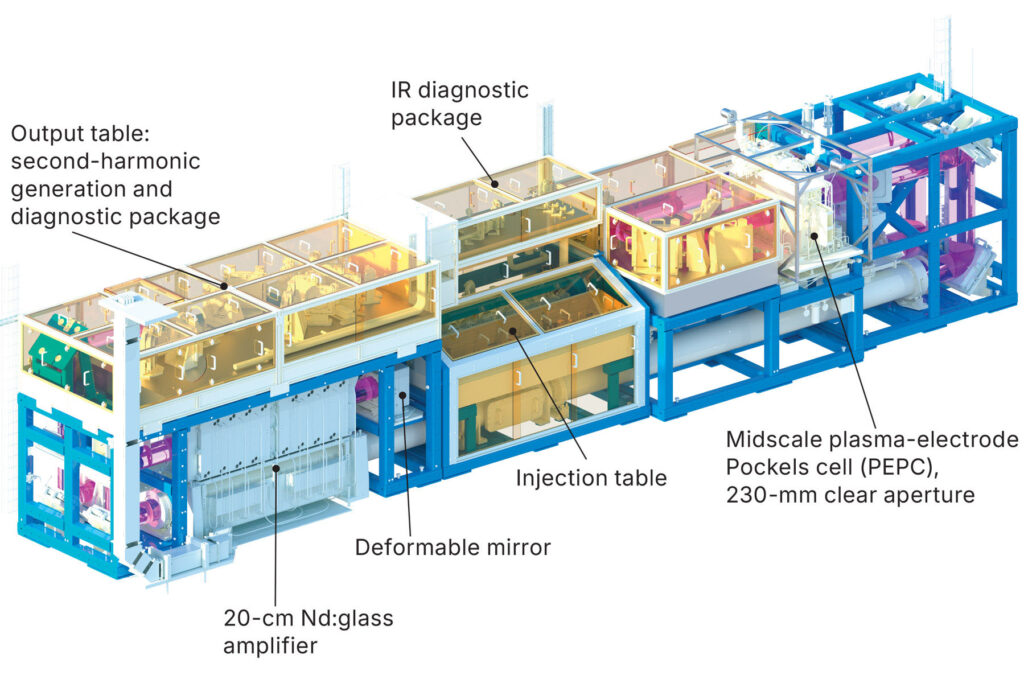
The pump pulse for the NOPA1 and NOPA2 stages originates from a diode-pumped Nd:YLF laser system (crystal large-aperture ring amplifier, CLARA), which is similar to the pump lasers used in the front ends of the Multi-Terawatt (MTW) laser, the short-pulse beamlines of the OMEGA EP beamlines, and the MTW-OPAL system. A newly developed flashlamp-pumped Nd:glass AMICA (active multipass imaged cavity amplifier) laser system delivers a total of 400 J in two time-multiplexed narrowband pump pulses for the COPA and SFG stages. This pump laser uses laser amplification from an OMEGA 20-cm disk amplifier, polarization switching in and out of its cavity using a newly developed midscale plasma-electrode Pockels cell (a smaller-aperture version of the one used on OMEGA EP), and wavefront correction using a deformable mirror as an end-cavity mirror. A time delay between the COPA and SFG stages overlaps in time each pump pulse with the broadband input pulse.
On FLUX, two NOPA stages and one high-energy COPA stage amplify broadband incoherent seed pulses. The idler output is removed after each of the NOPA stages, while both the signal and idler from the COPA stage propagate in the same direction to essentially double the output energy and bandwidth in the infrared. Producing high-energy UV pulses requires broadband SFG, which combines nonlinear optics with angular dispersion from two diffraction gratings [4]. The first grating disperses the broadband infrared beam relative to the pump beam. This angular dispersion, in combination with noncollinearly coupling the infrared beam and pump beam and tuning the SFG crystal, angularly sets the different spectral components of the broadband input to optimize the conditions for efficient SFG. A second diffraction grating, located after the SFG crystal, removes the angular dispersion of the broadband ultraviolet output so that spectral components propagate in the same direction. Residual bandwidth dispersion can provide beam smoothing by spectral dispersion on target to maximize laser drive uniformity [6].
FLUX aims to deliver laser pulses with UV bandwidth up to 1.5%, which is approximately 10× more than previous high-energy solid-state laser systems. FLUX supported energies up to 20 J for initial target experiments in April 2025, and a campaign currently underway will ramp FLUX energy to deliver more than 100 J for experiments in early 2026.
How FLUX Enables Advances
FLUX is a powerful new tool to experimentally test the mitigation of LPIs in direct-drive experiments. Its unprecedented bandwidth and flexibility enable experiments to
- study LPI mitigation and possibly even suppression as a function of bandwidth,
- test new diagnostic tools for tracking plasma waves and backscattered light, and
- validate next-generation simulation codes and theoretical models for laser–plasma interaction.
Results from FLUX target experiments will guide the design of next-generation ICF facilities. Laser–plasma instabilities have stood as one of the most persistent barriers in the decades-long pursuit of ICF. FLUX marks a major stride forward by strategically targeting the root causes of these phenomena with an innovative broadband laser system. With experiments supported by FLUX and OMEGA, understanding LPIs and ways to control them will accelerate with the goal of unlocking the potential of fusion.
Corresponding author: C. Dorrer