


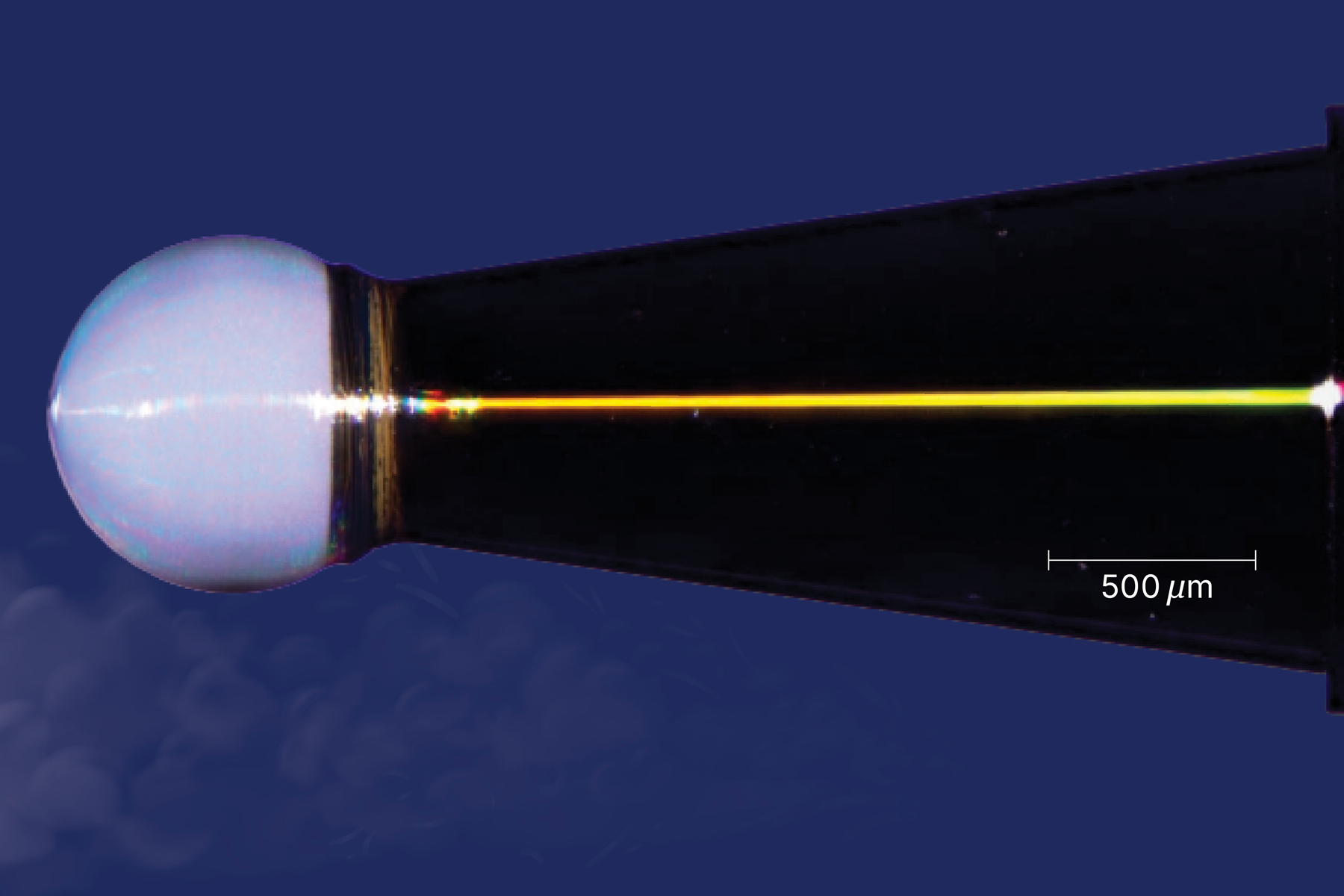
A new gas puffer system (GPS) is transforming how fusion scientists fill cryogenic targets, turning precise whiffs of deuterium gas into liquid fuel and opening the door to next-generation “wetted-foam” target experiments on the OMEGA Laser System.
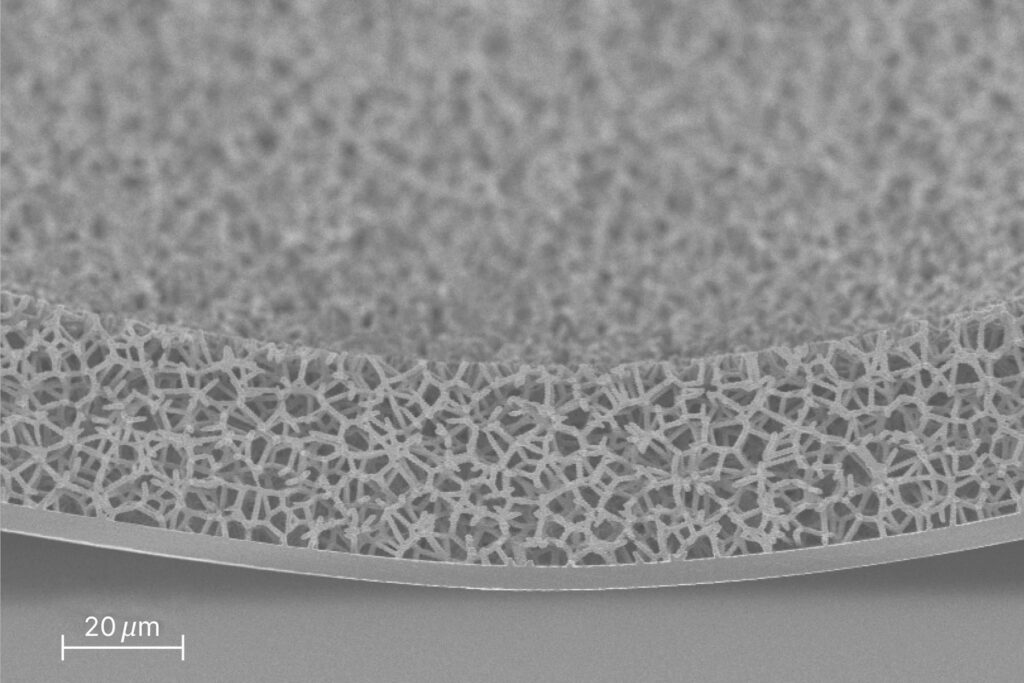
Cryogenic implosions are fundamental to fusion research at LLE. In these experiments, tiny fuel-filled targets are cooled to extremely low temperatures and compressed by OMEGA to produce fusion reactions. Typical cryo implosions use solid layers of fuel, but some of today’s most advanced target designs include a wetted-foam layer—an ultrafine, 3D-printed internal structure into which cryogenically cooled liquid fuel wicks. Fuel in liquid form offers scientists greater flexibility when designing cryogenic implosions.
A New Way to Fuel Targets
The new Planar Cryo Gas Puffer System uses carefully timed, millisecond-scale bursts of deuterium gas to fill these delicate targets more reliably and with far greater control than ever before. The image above shows one example of these targets, which appears milky white from the foam structure.
Traditional fill methods are slow and finicky. Any setback can cause long delays, and even when successful, these methods tend to fill the entire capsule and its fill cone with liquid fuel, more than many experiments require. For wetted-foam designs, researchers ideally want to wet only the foam layer with a thin, precisely placed film of liquid.
The GPS, currently mounted on planar cryogenic target carts used in OMEGA, was created to make selective filling possible. Inside the chilled capsule, held between 20 to 25 K (about –400°F), each “puff” of gas condenses into liquid as it enters the target and fills the foam layer. The long-term goal is to confine the liquid entirely to that foam structure rather than flood the whole capsule.
Inside the Technology
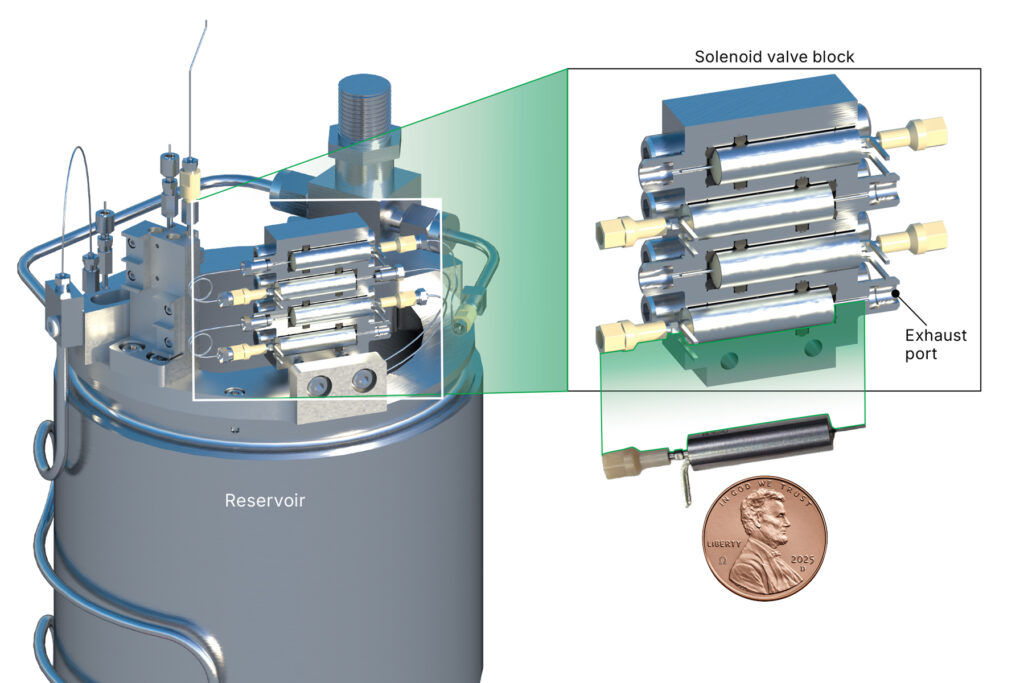
At the core of the GPS is an unexpected piece of hardware: the same type of miniature solenoid valves found in commercial inkjet printers (rendering above). These fast-acting valves, paired with precision microfilters, are set up in a “trapped volume between two valves” configuration that has been used successfully for gas delivery in other applications at LLE. The valves open and close in milliseconds to deliver highly reproducible gas pulses.
The GPS integrates its valves, reservoir, thermal controls, and vacuum exhaust into a compact assembly that mounts cleanly on a planar cryogenic cart (moving cryostat). Operators monitor the fill progression in real time and stop at the desired point, enabling consistent wetting patterns and repeatable cryogenic conditions. Carts can switch between standard tank fills and GPS mode in one to two hours with no realignment.
Advanced 3D-Printed Foams
Many of these next-generation targets use two-photon polymerization (2PP), a cutting-edge 3D-printing technique that builds microscopic foams and internal layers with extraordinary precision. These advances in target fabrication are a major reason the wetted-foam concept is gaining momentum today. For more information on 2PP, see LLE In Focus Issue 5, Winter 2025, page 14.
Why It Matters
The GPS system enables scientists to exploit several key advantages that liquid fuel has over solid-layered fuel in cryogenic targets: greater implosion stability, faster ablation, and tunable vapor pressure, while giving researchers control over how fuel is positioned inside the target. With its gentle, low-stress fill process, the GPS also has the potential to benefit many other campaign platforms that have delicate targets. The GPS will support experiments studying ablation physics, shock timing, and laser–target interactions using these novel wetted-foam targets.
Wetted-foam targets are also important for the long-term vision of inertial fusion energy. For future power-plant concepts, these 2PP-printed, foam-based targets are easier and more cost-effective to mass-produce than traditional solid-layer capsules. The planar cryo GPS is the first step at LLE toward routinely fielding these designs on OMEGA.
From Concept to Reality
Development of the puffer approach began nearly a decade ago and accelerated in FY24–25. Over the past year, the team
- redesigned the valve block to improve assembly and maintenance ease,
- improved thermal-control systems,
- integrated the design onto a planar cryo cart, and
- field-tested the system in campaign operations.
Early tests necessarily filled the entire capsule and cone. The first generation of 2PP targets did not yet include the specialized interface required for GPS to connect directly to the foam layer. Updated targets, arriving in 2026, will enable the foam-only filling for which the GPS was designed.
During the recent Cryo-WetFoam-25A campaign, the first installed GPS successfully completed two operational fills, demonstrating reliable performance under real experimental conditions.
With two successful campaign fills already completed, the system has moved from concept to proven operational capability and the first step of a staged implementation is underway. A second GPS unit is now being installed to support higher shot cadence and campaign flexibility.
What’s Next
Successful deployment of the gas puffer system on a planar cryo platform is just the first step. Ultimately, the system will be adapted for use on spherical cryo campaigns. Once fully deployed, multiple GPS-filled cryogenic targets will be fielded each day, supporting wetted-foam studies across both planar and spherical cryo platforms.
Upcoming work includes
- installing the second GPS on a second planar cryogenic cart,
- refining valve-timing “recipes” to confine liquid precisely to the foam layer,
- studying liquid distribution in advanced 2PP-fabricated shells and foams, and
- exploring in situ x-ray imaging to visualize wetting inside the target.
These efforts lay the groundwork for future symmetric, fully spherical (4π) direct-drive cryogenic implosions using wetted-foam capsules, an important milestone for advanced cryogenic target development and inertial fusion energy concepts. Together with recent advances in 3D-printed target fabrication, these efforts place LLE at the cutting edge of wetted-foam experimental development.
Corresponding author: B. Ehrich
A version of this article appears in Issue 8 of LLE In Focus, the magazine of the University of Rochester’s Laboratory for Laser Energetics