Timeline – 2013
OMEGA Completes Record 25,000 Experiments
On September 12, 2013, the OMEGA Laser System completed a record 25,000 experiments.
“The University of Rochester’s Laboratory for Laser Energetics plays an important role in advancing NNSA’s national security missions. It has made significant contributions to the Stockpile Stewardship Program,” said NNSA Deputy Administrator for Defense Programs Don Cook.
“The Laboratory operates Omega as a very effective user facility. I congratulate the Omega team on this accomplishment and thank LLE for its sustained contributions to the stockpile mission.”
4ω Probe Diagnostic Activated
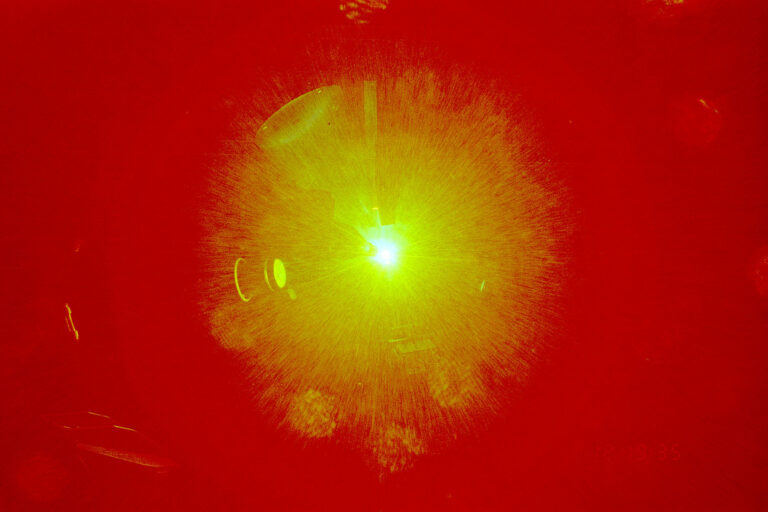
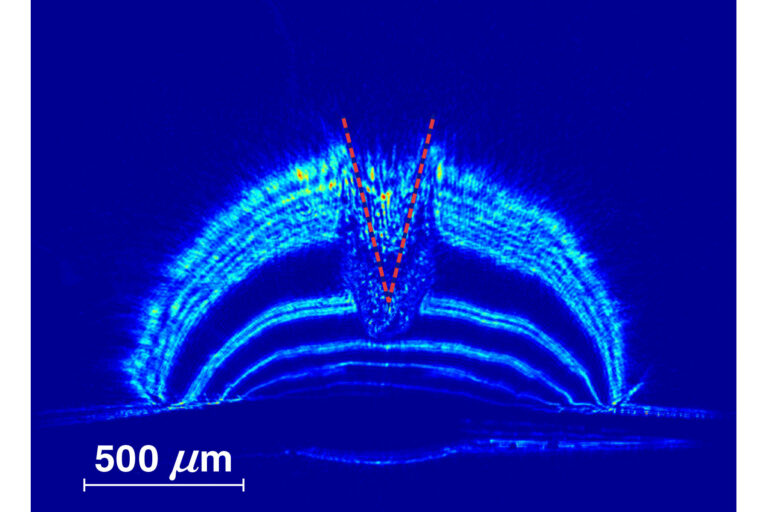
Shown is the first image obtained with the 4ω probe diagnostic implemented on the OMEGA EP Laser System. Operating at a wavelength of 263 nm, the probe beam illuminates a channel dug into a preformed plasma with a 1200-J infrared channeling beam. The f/2 focusing cone of the IR beam is shown in red. Data obtained with this diagnostic will provide a new view of plasmas relevant for inertial confinement fusion.
Neutron Time-of-Flight Detector
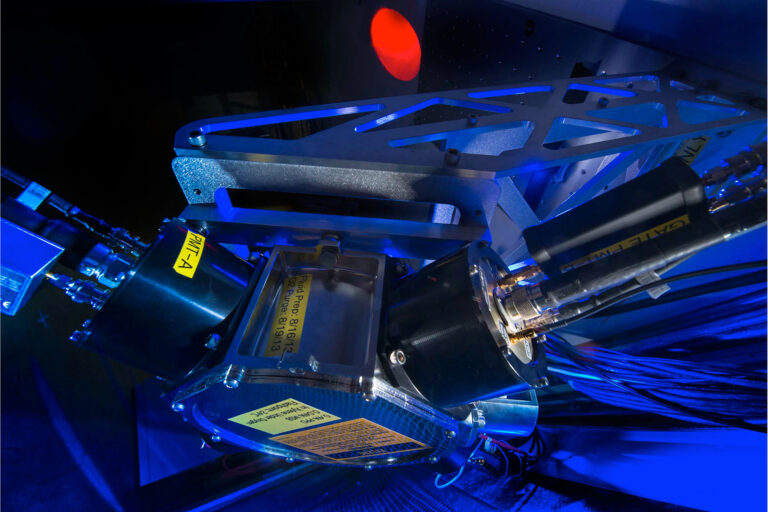
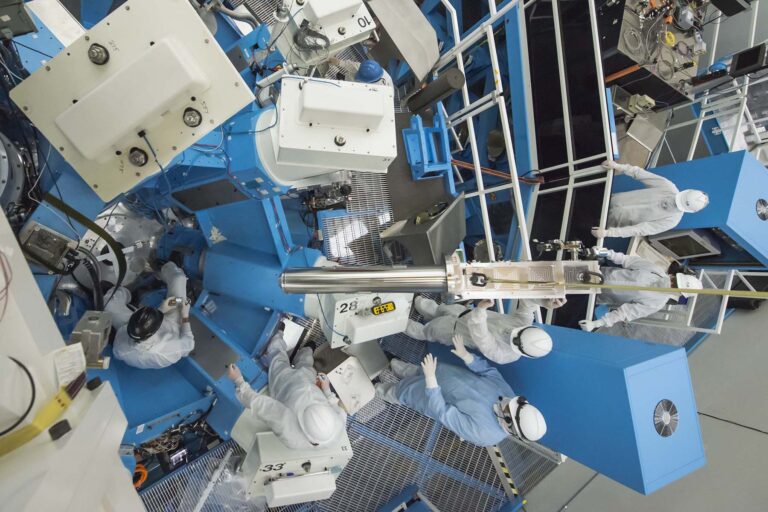
A new neutron time-of-flight (nTOF) detector was qualified for use on OMEGA. This detector is similar to an earlier device but has a larger scintillator volume for improved signal-to-noise measurements of deuterium–tritium fusion neutrons that scatter in the compressed fuel of cryogenic implosions. The spectrum of the scattered fusion neutrons is one of the key measurements used to infer the implosion performance.
The detector includes additional photomultiplier tubes configured to measure different parts of the neutron spectrum emitted during such implosions. All of the neutron-spectrum–based implosion-performance measurements can now be made along a single line of sight from the target. The red ellipse shows the location of the hole in the Target Bay floor that is part of the collimated line of sight from the target chamber center to the detector.
Implementation of a New Neutron Temporal Diagnostic
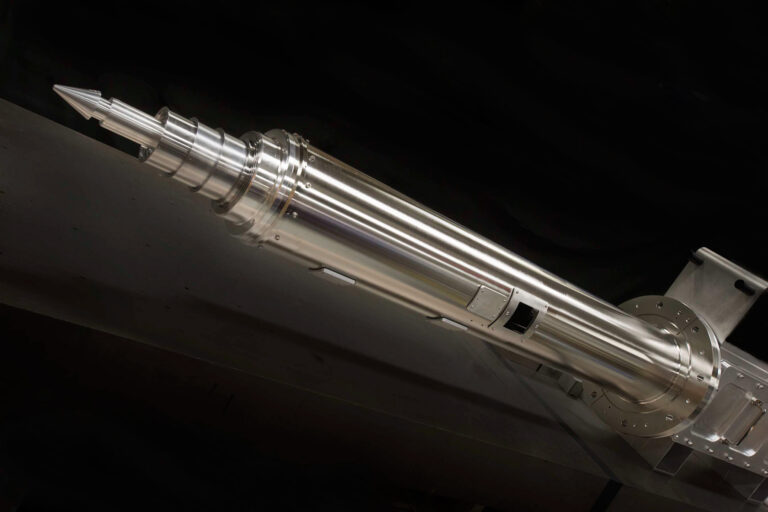
The OMEGA neutron temporal diagnostic (NTD) was replaced with a ROSS streak-camera–based system. The new diagnostic included a ROSS streak camera, a new optical relay system, and a new motion control system for the scintillator nose cone.
The new assembly makes it possible to change out nose cones without a target chamber entry, which will facilitate more frequent NTD calibration. The impulse response of the ROSS-based system is better characterized, reducing the uncertainty in the inferred cryogenic implosion pressures.
The NTD measures the temporal history of neutron production in inertial confinement fusion implosions, and the temporal history measurement is used to infer important performance parameters from cryogenic deuterium–tritium implosions at LLE (e.g., bang time, burn rate, and peak pressure in the fuel).
The new hardware improves the impulse response of the instrument, which will reduce the uncertainty in these performance parameters.
A New Type of Coil for Magnetized Plasma Experiments
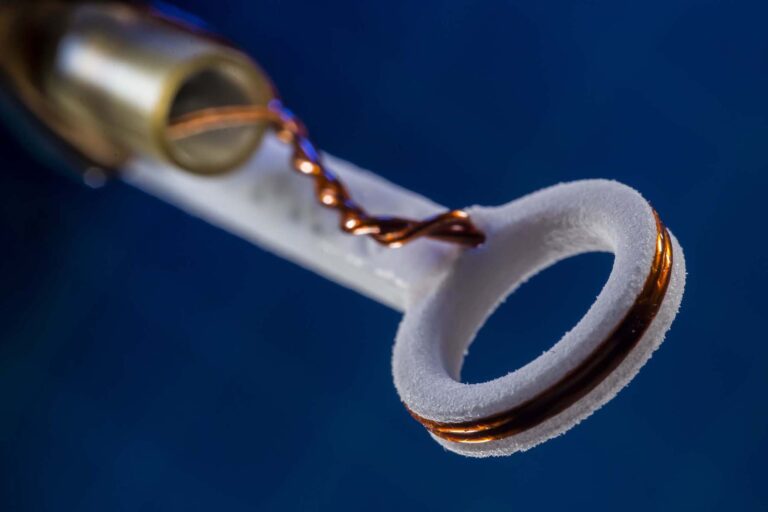
A new type of coil for magnetized plasma experiments at LLE was designed and fabricated. The coils consist of several turns of Kapton-insulated wire wound around a nylon coil form. The multiturn design results in a high magnetic field. The coil form itself is 3D printed, which allows for virtually an unlimited number of possible precise configurations. In order for the magneto-inertial fusion electrical discharge system (MIFEDS) to create intense magnetic fields, tens of kiloamperes of electricity are generated by the MIFEDS and travel through the coil.